




So, Who Is This Newcomer?
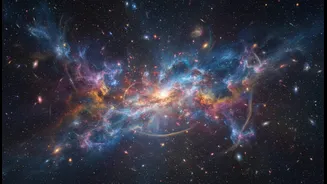
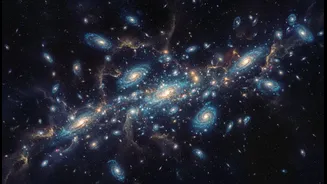
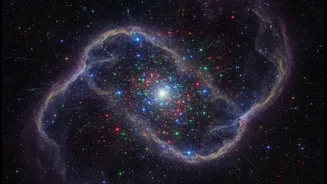
MACS J0553, formally known as MACS J0553.4-3342, isn't a person, but a gigantic structure in the universe located about 4.4 billion light-years away in the constellation Columba. It’s a galaxy cluster, one of the largest known objects in the cosmos held
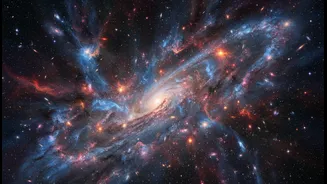
together by gravity. Think of it not as a single city of stars, but a sprawling metropolitan area made of multiple cities (galaxies) all bound together. Recent observations with the James Webb Space Telescope (JWST) have revealed that MACS J0553 is a messy, chaotic construction site. It’s composed of two smaller galaxy clusters that have smashed through each other and are in the process of merging. This cosmic crash gives scientists a rare opportunity to study how the different components of the universe behave under extreme conditions.
The DM That Went Missing
Here’s where the drama begins. The universe is mostly made of stuff we can’t see. About 85% of all matter is thought to be 'dark matter', an invisible substance that doesn’t emit or reflect light but can be detected by its gravitational pull. The reigning theory, called the Lambda Cold Dark Matter (ΛCDM) model, predicts how this dark matter should behave. During a galaxy cluster collision, the normal matter (the hot gas between galaxies) should slow down due to friction-like forces, while the dark matter, which barely interacts, should sail right through. This has been observed before in famous collisions like the Bullet Cluster, providing strong evidence for dark matter's existence. But MACS J0553 didn’t follow the script. Instead of finding a big clump of dark matter where it was expected, astronomers found a surprisingly flat and spread-out distribution. The dark matter seems to be much less concentrated than predicted, sending a shockwave through the astrophysics community.
Why the Group Chat Is Freaking Out
Imagine a group chat where everyone has agreed on a fundamental rule. For decades, astronomers have relied on the ΛCDM model to explain the large-scale structure of the universe. It's been incredibly successful. Collisions like the Bullet Cluster were seen as poster children for this model, showing dark matter and normal matter separating exactly as predicted. Now, MACS J0553 has burst in with a contradictory message. Its oddly diffuse dark matter halo challenges the 'Cold Dark Matter' part of the model. 'Cold' means the particles are slow-moving and should clump together tightly under gravity. The smoothness of the dark matter in MACS J0553 suggests it might not be so 'cold' after all, or that it might interact with itself in ways we don't understand — a property known as self-interaction. This one observation doesn't break the entire theory, but it's a significant anomaly that can't be easily ignored.
Rewriting the Cosmic Playbook
This discovery forces scientists to ask some hard questions. Is there something unique about MACS J0553's three-way collision that produced this strange result? Or is our fundamental understanding of dark matter incomplete? While the ΛCDM model has been robust, it isn't without its issues, such as discrepancies in the expansion rate of the universe (the Hubble tension) and problems predicting the structure of small galaxies. MACS J0553 adds a new, compelling piece to this puzzle. The finding doesn’t mean dark matter isn’t real; rather, it suggests its nature could be more complex. Perhaps dark matter particles can interact with each other, creating a form of pressure that smooths out their distribution in violent collisions. This would require an update to the standard model, moving from a simple, collisionless particle to something more intricate.
What Happens After Dropping a Bomb in the Chat?
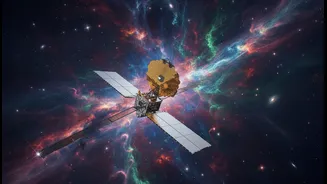
The immediate next step for astronomers is to find and study more colliding galaxy clusters to see if MACS J0553 is a one-off freak or the first example of a new class of object. The power of the James Webb Space Telescope is crucial here, as its sensitivity allows for the detailed mapping of these faint gravitational effects that reveal the location of dark matter. Each new data point, whether it confirms the old model or challenges it, brings us closer to the truth. Science doesn’t advance through unwavering certainty, but through the rigorous testing of its own foundational ideas. MACS J0553 hasn't ended the conversation on dark matter; it has just made it infinitely more interesting.