






What is 'Rotating' Light?
Imagine light as a wave that oscillates, or wiggles, as it travels. The orientation of this wiggle is called its polarization. According to the established laws of physics, the polarization of light should remain fixed as it journeys through the vast
emptiness of space. However, some scientists have found hints that this isn't the case for the oldest light in the universe. This phenomenon, known as 'cosmic birefringence', suggests that the plane of polarization has been slowly rotating on its 13.8 billion-year journey to Earth. This effect is incredibly subtle, with measurements suggesting a rotation of only about a third of a degree, but the implications are enormous.
Clues From the Dawn of Time
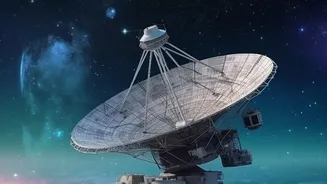
The evidence for this cosmic rotation comes from studying the Cosmic Microwave Background (CMB), the faint afterglow of the Big Bang. This ancient light, released when the universe was just 380,000 years old, permeates all of space and carries with it a snapshot of the early cosmos. Telescopes like the European Space Agency's Planck satellite and the Atacama Cosmology Telescope have meticulously mapped the polarization of the CMB across the sky. Initial findings in 2020 hinted at a rotation, but it was difficult to be sure if the signal was truly cosmic or just an error caused by our own galaxy's dust or instrument miscalibration. However, more recent analyses using new methods have strengthened the case that the effect is real, finding a similar rotation in different datasets.
A Crack in the Standard Model?
The Standard Model of particle physics is one of the most successful scientific theories ever devised, explaining three of the four fundamental forces and classifying all known elementary particles. It has been tested and confirmed for decades. However, a key principle of the model is something called parity symmetry, which essentially means that the universe should not have a 'preferred' direction—a mirror image of a physical interaction should also be a possible interaction. A rotating light wave across the entire cosmos would violate this symmetry on a grand scale, something the Standard Model does not predict or account for. This discrepancy is what excites physicists; it's a potential crack in an otherwise solid theory, pointing toward 'new physics' that could help solve some of cosmology's biggest mysteries.
Searching for an Explanation
So, what could be causing the universe to twist light? The leading candidates are phenomena that are currently theoretical. One popular idea involves hypothetical particles called 'axion-like particles' (ALPs). If these particles exist and form a pervasive field throughout the universe, they could interact with photons (light particles) in a way that rotates their polarization over cosmic distances. This makes the search for cosmic birefringence a potential tool for detecting axions, which are also considered a candidate for the elusive dark matter that makes up most of the matter in the universe. Another possibility is that dark energy, the mysterious force driving the universe's accelerated expansion, could have properties that violate parity symmetry and interact with light.
What Comes Next?
While the evidence for cosmic birefringence has grown stronger, it has not yet reached the 'gold standard' of 5-sigma statistical significance required to claim a definitive discovery. The current evidence sits around a 2.4 to 4-sigma confidence level, which is tantalizing but not yet conclusive. The main challenge is precisely accounting for all possible sources of error, from the dust in our own Milky Way to the precise calibration of the telescopes. Future observatories like the Simons Observatory are being designed with this puzzle in mind. They will use advanced calibration techniques to make more precise measurements of the CMB's polarization, hopefully confirming whether this cosmic rotation is a revolutionary discovery or a subtle instrumental effect.