




A Perfect Touchdown
In its latest test, ISRO demonstrated the advanced capabilities of its Reusable Launch Vehicle (RLV) prototype. The winged vehicle, named 'Pushpak', was carried to an altitude of 4.5 kilometres by an Indian Air Force Chinook helicopter and released mid-air.
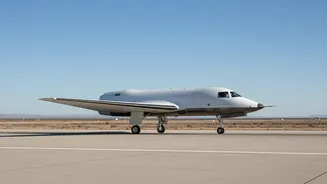
From there, everything was up to Pushpak. The vehicle autonomously navigated its way to the runway, corrected its course against winds, and performed a precise, high-speed landing at over 320 km/h at the Aeronautical Test Range in Chitradurga, Karnataka. After touchdown, it used a brake parachute to slow down before coming to a complete stop using its landing gear brakes. This recent test was part of a series of landing experiments (LEX) designed to prove the vehicle's ability to land perfectly on its own, a vital step for any reusable spacecraft.
Why Reusability is the Holy Grail
Think of traditional rockets as single-use machines. The most expensive parts—the powerful engines and complex structures—are built at great cost only to be discarded in the ocean or burn up in the atmosphere after just one flight. Reusable launch vehicles aim to change this fundamentally. By designing a vehicle that can fly to space and then return to land on a runway like an airplane, the massive cost of building a new rocket for every single mission is eliminated. This is the core idea that has allowed companies like SpaceX to dominate the commercial launch market. ISRO's goal is similar: to drastically reduce the cost of placing satellites into orbit, potentially by a factor of ten. This would make India an even more competitive player in the multi-billion dollar global satellite launch industry.
Meet Pushpak: India's Space Shuttle
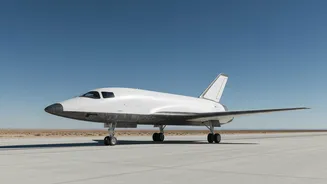
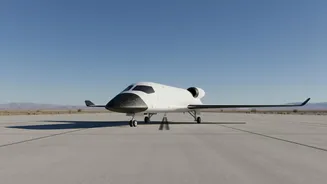
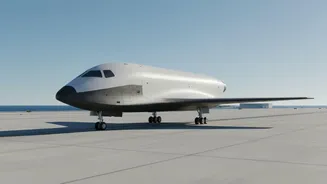
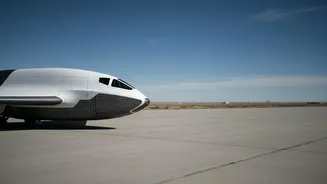
Pushpak is a technology demonstrator, a testbed for the technologies ISRO needs to master to build a full-scale, operational RLV. It's a spaceplane with a winged body, double delta wings, and twin vertical tails, a design that helps it glide back through the atmosphere. The recent landing tests have been crucial for validating its autonomous navigation, guidance, and control systems. These systems use a sophisticated fusion of sensors, including ISRO's own NavIC satellite navigation system, to perform the complex manoeuvres required for a high-speed, unmanned landing. The vehicle that flew in the latest test reused the airframe and systems from a previous flight, proving the hardware's robustness and reuse capability.
The Challenge of an Autonomous Landing
Landing a winged vehicle from a high altitude without a pilot is an immense engineering challenge. The vehicle has to manage its speed and approach angle perfectly, a task made harder by its low lift-to-drag ratio, which necessitates a very fast landing. The autonomous systems must perform flawlessly, processing data from multiple sensors to make real-time corrections for factors like wind speed and direction. The latest tests were deliberately made more challenging, with the vehicle being released at a greater side distance from the runway to test its ability to make significant cross-range corrections before aligning for its final approach. Successfully completing these tests proves ISRO has mastered the critical technologies for the terminal phase of a space mission.
What Happens Next?
These landing experiments are just one part of a larger, step-by-step plan. Having proven hypersonic re-entry in an earlier test (HEX) and now autonomous landing (LEX), ISRO's next major goal is the Orbital Re-entry Experiment (ORE). In this future mission, a larger version of Pushpak will be launched into orbit on a conventional rocket. After spending some time in space, it will de-orbit, re-enter the atmosphere, and perform an autonomous landing back on a runway in India. This will be the ultimate test of the entire system, combining hypersonic flight, thermal protection from the heat of re-entry, and a precise landing. While an operational vehicle is still some years away, each successful test brings India closer to its goal of low-cost, on-demand access to space.