


A Visitor in the September Sky
In September 1882, something extraordinary appeared in the heavens. First spotted in the Southern Hemisphere, it quickly raced north, becoming a spectacle for the entire world, including the Indian subcontinent. It wasn't just a faint smudge; it was a phenomenon
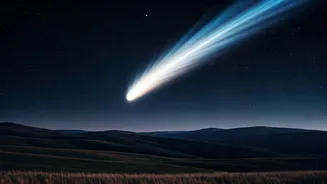
of incredible brilliance. Known today as the Great Comet of 1882, it was so bright that by the end of the month, people could see it with the naked eye during the daytime, a rare and startling event. Observers from Madras to Calcutta reported a majestic object with a long, shimmering tail stretching across a significant portion of the sky. For a population living without the constant glow of electric light, this celestial visitor would have been an unmissable, almost overwhelming, presence in their lives for weeks.
What Our Ancestors Saw
From the bustling port cities under British rule to the quietest rural villages, the comet's arrival would have been a major event. Without the instant scientific explanations we have today, interpretations would have varied wildly. For many, it would have been a source of awe and wonder—a divine brushstroke across the cosmos. For others, it might have been an omen, a harbinger of change or misfortune, as comets have been viewed for millennia across cultures. Newspapers of the era, like The Times of India, would have carried reports from astronomers, but for the common person, the experience was visceral. It was a shared spectacle, a topic of conversation in markets, temples, and homes. It was a reminder of a universe far larger and more mysterious than the immediate world, a humbling and perhaps frightening sight that broke the predictable rhythm of the sun, moon, and stars.
The Science Behind the Spectacle
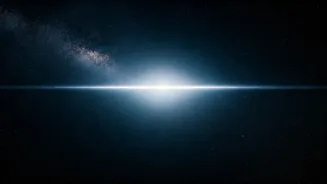
So, what was this 'dazzling sky glare'? The Great Comet of 1882 was a member of a special family known as Kreutz sungrazers. These are comets whose orbits take them exceptionally close to the Sun. As the 1882 comet approached our star, the intense heat and radiation caused its icy nucleus to vaporize at a tremendous rate. This process released enormous clouds of gas and dust, which were then pushed away by solar wind and radiation pressure to form its spectacular, multi-streamered tail. Its proximity to the Sun is what made it bright enough to be seen during the day. Comets are essentially cosmic snowballs of frozen gases, rock, and dust—relics from the formation of our solar system over 4.6 billion years ago. This particular one offered astronomers a golden opportunity for study.
A Turning Point for Astronomy
While it mesmerized the public, the Great Comet of 1882 was also a pivotal moment for science. It was one of the first comets to be studied using two revolutionary techniques: photography and spectroscopy. Astronomers were able to capture detailed photographs of a comet for the first time, preserving its image for future study long after it had faded from view. More importantly, using spectroscopy—the analysis of light by splitting it into its constituent colours—scientists could determine the chemical composition of the comet's tail. They found familiar elements like sodium, confirming that the building blocks of the cosmos were not so different from our own. This event helped shift the study of comets from mere observation of their paths to a deeper understanding of their physical nature.
The Comet's Fiery Fate
The same force that made the comet so brilliant also sealed its doom. The immense gravitational pull of the Sun during its close pass was too much for the comet to withstand. Observers watched as its nucleus broke into several large fragments, each continuing along a similar orbit. This act of cosmic destruction means the Great Comet of 1882 will never return as a single entity. However, its story isn't over. Astronomers predict that its fragments will return to the inner solar system as a series of smaller, separate comets over the coming centuries. The dazzling glare that moved across India's sky over 140 years ago has left an echo, a promise of future celestial visitors born from its fiery passage.