


Why Bodyweight Training Is So Effective
The idea behind bodyweight training is simple: use your own weight as resistance to challenge your muscles. This method is not only convenient and completely free, but it is also incredibly effective for building functional strength, which helps with
everyday movements and improves overall stability. Research has shown that bodyweight exercises, often called calisthenics, can produce comparable improvements in muscle strength to traditional weight training. It’s a time-tested approach that proves you don't need a rack of weights to build a stronger body; you just need to know how to use the one you already have.
The Secret to Getting Stronger: Progressive Overload
To 'build strength fast', you need to understand the principle of progressive overload. This simply means you must continually make your workouts more challenging over time to force your muscles to adapt and grow. Without weights, you can achieve this by: increasing your repetitions (reps), performing more sets, reducing rest times between sets, or slowing down the movement to increase the time your muscles are under tension. Another key method is to progress to more difficult variations of an exercise. For example, once you master squats, you might try pause squats or single-leg variations. This constant adaptation is the true engine of strength gains.
The Foundational Full-Body Workout Routine
For beginners, the best approach is a full-body workout that hits all the major muscle groups. Aim to perform this routine three times a week on non-consecutive days to give your muscles adequate time to recover and grow. For each exercise below, perform 3 sets. Take a 60 to 90-second rest between each set. Focus on maintaining proper form above all else; it's better to do fewer reps correctly than many reps poorly.
Exercise 1: The Bodyweight Squat
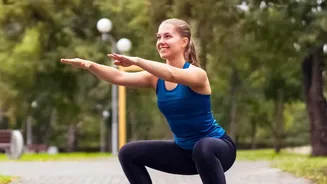
The squat is a powerhouse movement, targeting your quadriceps, hamstrings, and glutes. Stand with your feet shoulder-width apart and your chest up. Lower your hips back and down as if you’re sitting in a chair, keeping your back straight and your knees behind your toes. Go as low as you can comfortably, ideally until your thighs are parallel to the floor, then drive back up through your heels to the starting position. Aim for 10-15 reps. For an easier start, practice by squatting down to a sturdy chair and standing back up.
Exercise 2: The Push-Up (and Its Variations)
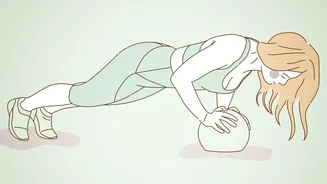
The push-up is the gold standard for upper-body strength, working your chest, shoulders, and triceps. Start in a high plank position with your hands slightly wider than your shoulders. Keeping your body in a straight line from head to heels, lower yourself until your chest is close to the floor, then push back up. If this is too difficult, start with incline push-ups against a wall or sturdy table, or perform them on your knees. Aim for 8-12 reps.
Exercise 3: The Lunge
Lunges are excellent for building single-leg strength and stability. Step one foot forward and lower your hips until both knees are bent at a 90-degree angle. Your front knee should be above your ankle, and your back knee should hover just above the ground. Push off your front foot to return to the start. For beginners, reverse lunges (stepping backward) can feel more stable. Perform 10-12 reps on each leg.
Exercise 4: The Plank
The plank is a core-defining exercise that builds endurance in your abs, back, and shoulders. Position yourself on your forearms with your elbows directly under your shoulders and your body forming a straight line from your head to your feet. Brace your core and don't let your hips sag. Hold this position for 30-60 seconds. If you're a beginner, you can start with a 15-20 second hold and build up from there.
Exercise 5: The Glute Bridge
This move targets your glutes and hamstrings, which are often underused if you sit for long periods. Lie on your back with your knees bent, feet flat on the floor, and arms by your sides. Pushing through your heels, lift your hips off the floor until your body forms a straight line from your shoulders to your knees. Squeeze your glutes at the top, then slowly lower back down. Aim for 12-15 reps.