




Squats and lunges are foundational for building strong, sculpted thighs, but are you performing them correctly? Mastering the right form is key to targeting different muscles and preventing injury, unlocking their full potential.
Why Strong Thighs Matter
Strong leg muscles are
more than just aesthetic; they are the foundation for your body's overall stability and mobility. The thigh muscles, which include the large quadriceps at the front and hamstrings at the back, power daily activities like walking, climbing stairs, and standing up from a chair. Strengthening them improves balance, can help prevent injuries by supporting your joints, and boosts your overall athletic performance. A powerful lower body creates a stable base that supports all other movements, making it an essential part of any balanced fitness routine.
Mastering The Classic Squat
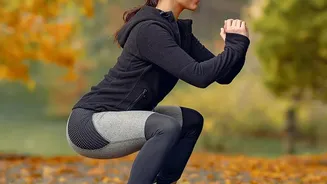
The squat is a powerhouse exercise, primarily engaging your quadriceps, hamstrings, and glutes. To perform a basic bodyweight squat correctly, stand with your feet about shoulder-width apart. Begin the movement by pushing your hips back and down, as if you are sitting in an invisible chair. Keep your chest lifted and your back straight, avoiding any rounding. Lower yourself until your thighs are parallel to the floor, ensuring your knees track in line with your toes and do not extend past them. Push through your heels to return to the starting position, squeezing your glutes at the top.
Squat Variations For Targeted Results
To focus on different areas of your thighs, simple adjustments to your squat stance can make a big difference. For targeting the inner thighs (adductors), the Sumo Squat is highly effective. This involves taking a stance that is significantly wider than shoulder-width, with your toes pointed slightly outward. As you squat down, you'll feel a greater stretch and activation in your inner thighs. Conversely, to place more emphasis on the quadriceps, you can adopt a narrower stance or try a heel-elevated squat. Placing a small weight plate under your heels allows for a more upright torso and deeper knee bend, intensifying the work on the front of your thighs.
The Essential Lunge: Form And Focus
Lunges are excellent for isolating each leg, which helps to improve balance and address muscle imbalances. To perform a forward lunge, stand with your feet together and your core engaged. Take a large step forward with one leg, lowering your hips until both knees are bent at approximately a 90-degree angle. Your front knee should be directly above your ankle, and your back knee should hover just above the ground. It's crucial not to let your front knee travel past your toes. Push off your front heel to return to the starting position and repeat on the other side.
Lunge Variations To Sculpt Your Thighs
Like squats, lunges can be modified to shift the focus. The Side Lunge, or lateral lunge, is a fantastic variation for working the inner and outer thighs. From a standing position, step directly out to one side, keeping the other leg straight. Bend the knee of your leading leg and push your hips back, feeling the stretch in your straight leg. Another effective variation is the Curtsy Lunge. This move involves stepping one leg diagonally behind the other, as if performing a curtsy. This angle specifically targets the outer thighs and the gluteus medius, a key stabilizing muscle on the side of your hip.
Safety First: Avoiding Common Mistakes
Proper form is nonstoppable for preventing injury. A frequent mistake in both squats and lunges is allowing the knees to collapse inward. This 'knee valgus' can put significant stress on your joints. Focus on keeping your knees aligned with your second toe throughout the movement. Another common error is leaning too far forward, which can strain the lower back; keep your chest up and core engaged to maintain a neutral spine. In lunges, stepping one foot directly in front of the other like you're on a tightrope can make you unstable. Instead, imagine your feet are on train tracks, maintaining a hip width distance to create a more stable base.