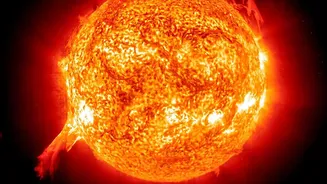



In a landmark achievement for space science, teams from India's Aditya-L1 and the European Space Agency's Proba-3 missions have published their first joint analysis of solar outbursts, offering an unprecedented look at our star's violent activity.
Two Missions, One Star
At the
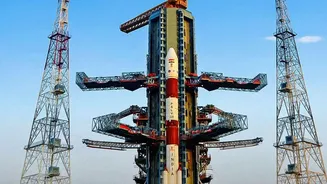
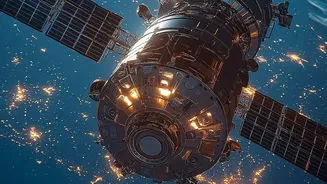
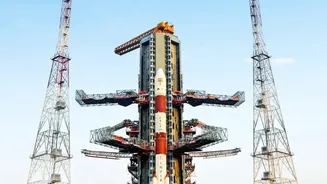
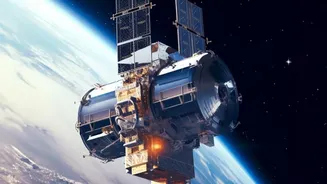
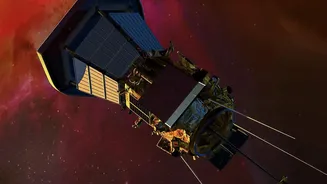
heart of this collaboration are two of the most sophisticated solar observatories ever launched. India's Aditya-L1, which reached its orbital home at Lagrange point 1 (L1) in January 2024, has a suite of seven instruments designed for a comprehensive study of the Sun. From this vantage point 1.5 million kilometres from Earth, it enjoys an uninterrupted view of the Sun, tracking everything from the solar corona to the solar wind. Its key instrument for this study, the Visible Emission Line Coronagraph (VELC), provides critical data on the corona, the Sun's superheated outer atmosphere. Meanwhile, the European Space Agency's (ESA) Proba-3 mission, launched by an ISRO PSLV rocket in December 2024, is a marvel of engineering. It's the world's first precision formation-flying mission, comprising two satellites that fly in a rigid alignment, 150 meters apart. One satellite blocks the Sun's bright face, creating a perfect, long-duration artificial eclipse for the other. This allows its primary instrument, the ASPIICS coronagraph, to capture stunningly clear images of the faint, inner corona—a region notoriously difficult to observe.
A Partnership Born of Complementary Strengths
The collaboration between ISRO and ESA is not new, with agreements spanning decades and covering areas like mission support and Earth observation. This partnership on solar science, however, represents a significant step forward, particularly after space weather was added as a key area for joint work. The logic is simple: what one mission sees, the other complements perfectly. Proba-3's unique formation flying provides the clearest-ever view of the 'birthplace' of solar outbursts, right at the Sun's edge. Aditya-L1's VELC instrument uses a different technique called spectroscopy to measure the properties of the plasma—like its density and temperature—within these eruptions. By combining the high-resolution images from Proba-3 with the detailed physical measurements from Aditya-L1, scientists can build a complete, three-dimensional picture of a solar event from its first moments. This was previously impossible with single-spacecraft observations.
First Findings: A Tale of Two Eruptions
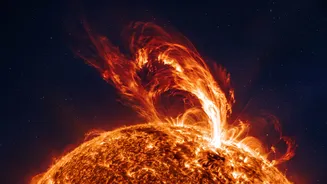
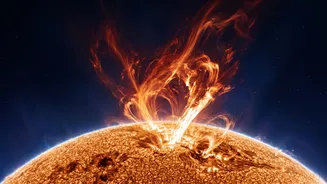
The team's first joint publication, which appeared in the journal 'Astronomy & Astrophysics', focuses on two Coronal Mass Ejections (CMEs) observed in September 2025. CMEs are colossal expulsions of plasma and magnetic fields from the Sun. The first event was a fast_mover, travelling at roughly 645 km per second, while the second was much slower, at about 145 km per second. By combining data from VELC and ASPIICS, the researchers were able to independently calculate the mass, density, and energy of these CMEs more accurately than ever before. The analysis revealed that the slower CME expanded more rapidly in its initial stage and showed a different energy distribution compared to the faster one. This suggests that not all CMEs are created equal, and their early evolution dictates their subsequent behaviour as they travel through space.
Why This Matters for Life on Earth
While studying the Sun is a fundamental scientific pursuit, it has immensely practical implications. CMEs are the primary drivers of space weather. When one of these massive clouds of charged particles hits Earth, it can wreak havoc. These geomagnetic storms can disrupt power grids, damage or disable critical satellites responsible for GPS and communications, and pose a radiation risk to astronauts. Understanding the fundamental physics of how a CME forms and accelerates is the first step toward accurately predicting its potential impact. Better forecasting gives operators time to place satellites in safe mode and protect vulnerable infrastructure on the ground. This joint analysis provides a crucial, missing piece of that puzzle by giving scientists a clear view of the 'crime scene' just as the event unfolds, rather than trying to figure it out from the aftermath.