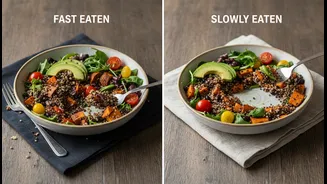









The Science Behind Slowing Down
The recommendation to eat slowly is rooted in the science of satiety. It takes approximately 20 minutes for your brain to receive and process signals from your gut that you are full. Hormones like ghrelin (the hunger hormone) and PYY and GLP-1 (fullness
hormones) are released in response to food. Eating at a more leisurely pace gives these hormones time to work, allowing your brain to register that you're satisfied before you've overeaten. Studies have consistently shown that faster eaters tend to have higher body mass indexes (BMIs) and are more likely to be overweight. Research from TCU found that people who ate slowly consumed fewer calories—up to 88 fewer per meal for normal-weight individuals—and reported feeling less hungry afterward. The logic is sound: by slowing down, you give your body’s natural appetite regulation system a chance to kick in, potentially reducing your overall intake at a meal.
Where Speed Alone Falls Short
While eating slowly can help control consumption during a single meal, it is not a foolproof strategy for long-term weight management. The primary reason is that body composition is ultimately governed by the principle of energy balance—calories in versus calories out. You can eat a large, high-calorie meal very slowly and still consume more energy than your body needs. The small calorie reduction seen in studies, such as the 58-calorie difference for overweight participants, might not be enough to create the significant, consistent calorie deficit required for meaningful weight loss on its own. Furthermore, focusing only on speed ignores the most critical variable in the equation: what you are actually eating. A large order of fries and a sugary soda eaten over 30 minutes is still a meal with low nutritional value that can contribute to weight gain. Speed is a tool for portion control, not a substitute for making conscious food choices.
Quality: The Non-Negotiable Foundation
Nutrient density refers to the amount of beneficial nutrients—vitamins, minerals, protein, and fiber—a food contains relative to its calorie content. Foods like leafy greens, lean proteins, and whole grains are nutrient-dense, while items like pastries and processed snacks are considered energy-dense or full of "empty calories." High-quality, nutrient-dense foods are more satiating. Protein and fiber, in particular, slow down digestion and help you feel fuller for longer. A diet rich in these components naturally helps regulate appetite and supports lean muscle mass, which is vital for a healthy body composition. Studies have shown a positive relationship between consuming non-nutrient-dense foods and higher body fat percentages. Therefore, a diet centered on whole, unprocessed foods provides the essential building blocks for your body and makes it easier to manage weight without feeling deprived. No matter how slowly you eat, a diet based on poor-quality foods is unlikely to yield positive changes in body composition.
Total Intake: The Unavoidable Math
Ultimately, weight management is a numbers game. To lose weight, you must consistently consume fewer calories than your body expends. Eating slowly can help you feel fuller on fewer calories, making it a useful behavioral strategy to help manage the "calories in" side of the equation. However, it doesn't change the fundamental math. A daily reduction of 50-100 calories from eating slowly can be easily undone by a single high-calorie snack or drink later in the day. The US Dietary Guidelines emphasize that controlling total calorie intake is the key recommendation for managing body weight. Focusing on eating speed without monitoring your overall daily intake is like trying to fix a leaky bucket by polishing the handle. The real solution lies in addressing the total volume of calories you consume across all meals and snacks throughout the day.
A Smarter, More Balanced Approach
Instead of viewing eating speed as a standalone solution, it’s more effective to integrate it into a broader, more holistic strategy. The goal is to combine mindful eating practices with a focus on food quality and quantity. Start by prioritizing nutrient-dense foods that will nourish your body and promote satiety. Pay attention to portion sizes, as even healthy foods contain calories. Then, use slow, mindful eating as a tool to better recognize your body’s fullness cues. Put your fork down between bites, chew thoroughly, and eliminate distractions like phones or TV during meals. This combination allows you to feel more satisfied with appropriate portions of high-quality food, making it easier to maintain a healthy calorie balance over the long term. Eating slowly supports your nutritional goals; it doesn't replace them.