




Venus: Earth's Hostile Sibling
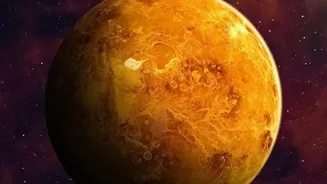
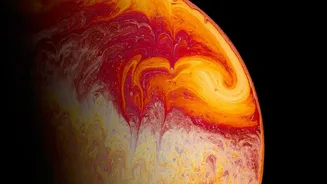
In size, mass, and composition, Venus is remarkably similar to Earth. Yet, it is the most hostile planet in our solar system. A runaway greenhouse effect has baked its surface to temperatures hot enough to melt lead, averaging over 460°C. The atmospheric
pressure is over 90 times that of Earth's, and its skies are permanently shrouded in thick clouds of sulfuric acid. For decades, scientists have wondered why this twin took such a dramatically different evolutionary path. Understanding this divergence is not just planetary science; it could offer crucial insights into climate models and the long-term future of Earth itself. It is this fundamental question that drives the global interest in our neighbouring planet.
Enter Shukrayaan: India's Next Great Space Odyssey
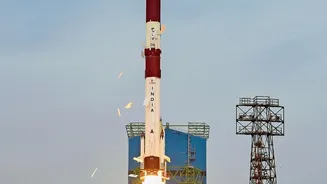
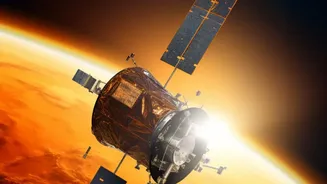
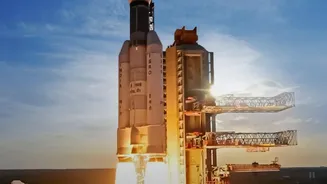
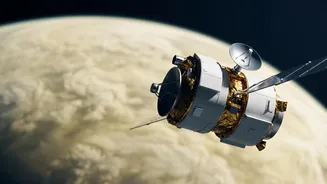
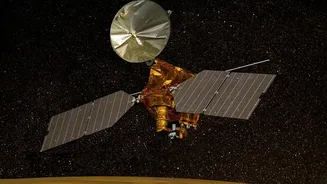
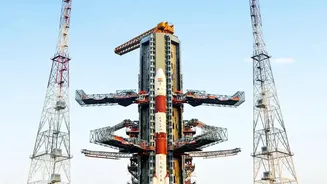
Following the historic successes of Chandrayaan to the Moon and Mangalyaan to Mars, the Indian Space Research Organisation (ISRO) is setting its sights on Venus. The Venus Orbiter Mission, unofficially known as Shukrayaan-1, is India's first dedicated mission to our celestial neighbour. Formally approved by the Union Cabinet on September 18, 2024, the mission is currently slated for a launch on March 29, 2028, aboard the powerful LVM-3 rocket. After a 112-day journey, the orbiter will enter a highly elliptical orbit around Venus, beginning a four-year mission to systematically map and study the planet from above.
The High-Tech Eyes and Ears of the Mission
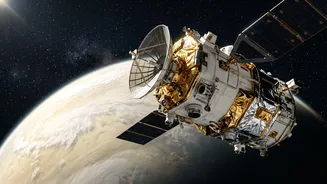
To probe Venus's secrets, Shukrayaan will carry a suite of around 19 scientific instruments, a mix of Indian-made and internationally collaborative payloads. The flagship instrument is a high-resolution Synthetic Aperture Radar (SAR), which can pierce through the dense cloud cover to map the planet's surface with unprecedented detail—up to four times the resolution of NASA's previous Magellan orbiter. For the first time ever, a mission will also carry a ground-penetrating radar to study the shallow subsurface, searching for geological layers and perhaps even hidden lava flows. These instruments will investigate Venus's volcanic activity, geological history, and surface features.
Probing the Clouds for 'Unique Signals'
Perhaps the most tantalizing part of Shukrayaan's mission is its focus on the Venusian cloud layers. The term 'unique signals' refers to the search for specific chemical and atmospheric phenomena that could explain the planet’s mysteries. A key target is the investigation of phosphine gas. On Earth, phosphine is overwhelmingly associated with biological or industrial processes, and its potential detection in Venus's clouds in 2020 sparked intense scientific debate about what could be producing it in such a harsh environment. Shukrayaan will carry instruments like the Venus Infrared Atmospheric Gases Linker (VIRAL), a collaboration with France and Russia, designed specifically to study atmospheric chemistry and confirm or refute the presence of such gases. The mission will also carry a lightning sensor to study electrical discharges within the clouds, providing more data on the dynamic and reactive nature of the Venusian atmosphere.
More Than a Search for Life
While the prospect of biosignatures is exciting, the search for 'unique signals' is much broader. These signals could also point to active volcanism releasing gases into the atmosphere or unknown chemical reactions occurring in the high-pressure, high-temperature environment. Other instruments, including a collaboration with Sweden called the Venusian Neutrals Analyser, will study how the solar wind interacts with the planet's upper atmosphere. This is crucial for understanding how Venus lost its water and evolved into its current state. By studying the structure, composition, and dynamics of the atmosphere, ISRO aims to build a comprehensive, global picture of the planet that previous, more limited missions could not.