
First Sighting and Tracking
The investigation begins with discovery. Using powerful ground-based and space telescopes, astronomers scan the skies for faint points of light moving against the backdrop of fixed stars. Surveys like the Catalina Sky Survey and Pan-STARRS take multiple
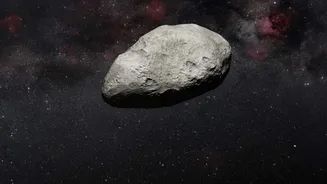
images of the same patch of sky minutes apart. If an object has shifted its position, it's flagged as a potential near-Earth object. Once spotted, astronomers around the world perform follow-up observations to plot its course. By taking at least three precise measurements of its position over time, they can calculate its trajectory and determine its orbit around the Sun. This tells them if it's a familiar object or a new discovery, and more importantly, allows them to trace its path backwards, offering clues to where in the solar system it might have originated, such as the main asteroid belt between Mars and Jupiter.
Decoding Light for Clues
You don't have to touch a space rock to know what it’s made of. The most powerful remote tool for this is spectroscopy. Astronomers analyse the spectrum of sunlight that reflects off an asteroid's surface. Different minerals and chemical compounds absorb and reflect specific wavelengths of light, creating a unique 'fingerprint'. For example, absorption bands in the near-infrared part of the spectrum can reveal the presence of minerals like olivine and pyroxene. This spectral fingerprint allows scientists to classify the asteroid (such as S-type for stony or C-type for carbonaceous) and compare its composition to the vast collections of meteorites that have fallen to Earth. If the spectral data from an asteroid matches the lab data from a specific type of meteorite, scientists can confidently link the two.
Bringing a Piece Home
While spectroscopy is incredibly powerful, nothing beats having a physical sample in a lab. Sometimes, the sample comes to us in the form of a meteorite. Other times, we have to go get it. This is the goal of ambitious sample-return missions. Japan's Hayabusa and Hayabusa2 missions successfully brought back dust from asteroids Itokawa and Ryugu, respectively. More recently, NASA's OSIRIS-REx mission returned a substantial sample from the carbon-rich asteroid Bennu in 2023. These pristine samples are invaluable because they contain fragile materials and compounds that would not survive the fiery descent through Earth's atmosphere. Analyzing this material directly allows for a much deeper understanding of the asteroid's chemistry and history.
The Clock in the Rock
Once a sample is on Earth, whether from a mission or a meteorite find, scientists can determine its age with incredible precision using radiometric dating. This technique measures the decay of radioactive isotopes within the rock's minerals. By analysing ratios of elements like uranium and lead, or aluminium and magnesium, researchers can pinpoint when the asteroid's parent body formed, often dating back to the very beginning of the solar system, around 4.56 billion years ago. Other isotopic ratios, like those of oxygen, can provide a unique signature for the specific parent body the meteorite came from, distinguishing it from rocks from Earth, the Moon, or Mars. These methods allow scientists to build a detailed timeline of the object's life, from its formation in the early solar nebula to its long journey through space.