



The Sun’s Turbulent Peak
Our sun operates on an approximately 11-year cycle, moving from a quiet period, known as solar minimum, to a turbulent peak called solar maximum. We are currently in Solar Cycle 25, which has been ramping up faster than originally predicted and is now at or near
its maximum. During this phase, the sun’s surface erupts with more sunspots, solar flares, and colossal explosions of plasma known as coronal mass ejections (CMEs). These events blast enormous amounts of energy and charged particles into space. While Earth’s magnetic field protects us on the ground, our technology in orbit is far more exposed to this volatile space weather.
An Invisible Drag on Satellites
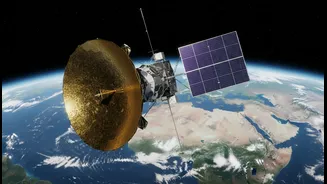
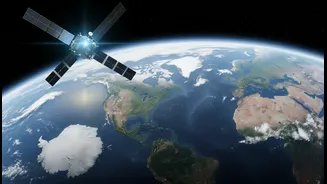
The primary threat to satellites in low-Earth orbit (LEO) during a solar maximum isn't a direct hit from a flare, but a more subtle effect: atmospheric drag. When a CME or solar flare sends a wave of energy toward Earth, it heats our planet's upper atmosphere, causing it to expand upwards. For satellites orbiting at altitudes below 1,000 kilometres—which includes the International Space Station and thousands of communication satellites like Starlink—this expansion means they are suddenly flying through denser air. This increased density acts like an invisible brake, creating drag that slows the satellites down and causes their orbits to decay faster and more unpredictably. During quiet solar periods, satellites might need orbital corrections a few times a year; during a solar maximum, this can increase to every few weeks.
The Power of Real-Time Tracking
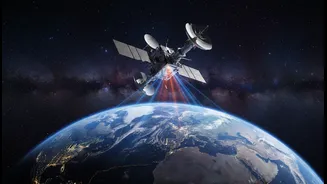
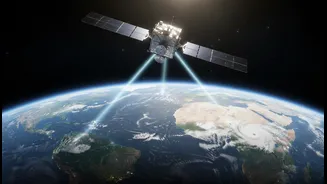
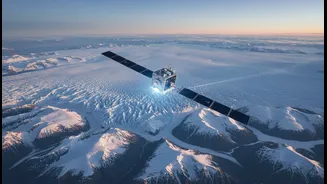
This is where real-time tracking becomes essential. Space agencies and commercial operators use a global network of ground-based radars and optical telescopes to constantly monitor the positions of tens of thousands of objects in orbit, from active satellites to defunct debris. This data is fed into complex models that can predict an object's trajectory. When a solar storm is detected by sun-observing satellites, forecasters can anticipate its impact on atmospheric density. This allows them to predict how satellite orbits will change, giving operators crucial advance warning. This process, known as space situational awareness (SSA), is the foundation of modern satellite safety.
From Prediction to Active Protection
With accurate, real-time data, satellite operators can take protective action. If a satellite's orbit is predicted to decay into a dangerous path, operators can fire its onboard thrusters to perform a collision avoidance manoeuvre (CAM), boosting it back to a safe and stable altitude. In an increasingly congested LEO, where thousands of satellites operate, avoiding collisions is a paramount concern. A single collision could create a cloud of thousands of new pieces of debris, triggering a cascade of further crashes. During intense radiation events, operators can also command satellites to enter a 'safe mode,' temporarily shutting down sensitive electronics to prevent permanent damage. These manoeuvres are critical for preserving billion-dollar assets and the services they provide.
A Global Effort With Indian Stakes
Safeguarding orbital networks is a global collaborative effort, with agencies like NASA and the European Space Agency (ESA) playing key roles. India, with its growing fleet of operational satellites vital for communication, earth observation, and national security, has a significant stake in this domain. The Indian Space Research Organisation (ISRO) is bolstering its own capabilities through Project NETRA (Network for space object TRacking and Analysis). This initiative aims to establish an independent capacity to monitor and predict threats from space debris and space weather, using a network of radars, telescopes, and a control centre in Bengaluru. As India's reliance on its space assets grows, projects like NETRA are crucial for ensuring their long-term sustainability and safety, especially during the sun's most active phases.