




The Sun’s Mysterious Middle Layer
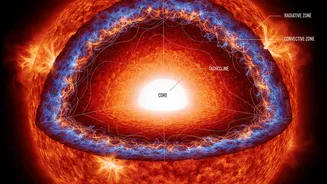
Imagine the Sun has layers, like an onion. Deep at the core is the radiative zone, a region so dense that energy takes thousands of years to crawl through. This core rotates like a solid, stable ball. The outermost 30% is the convection zone, a chaotic,
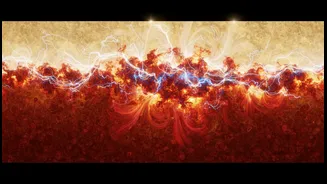
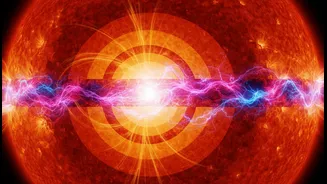
boiling sea of plasma where hot gas rises, cools, and sinks, much like water in a pot. This outer layer rotates differentially, meaning the equator spins faster than the poles. Between these two vastly different regions lies the tachocline. It is an incredibly thin boundary, less than 5% of the Sun's radius, but it has the monumental task of bridging the gap between the rigid rotation of the interior and the turbulent, differential rotation of the surface. This sharp transition creates immense shear, like two powerful rivers flowing past each other at different speeds.
The Engine Room of the Solar Dynamo
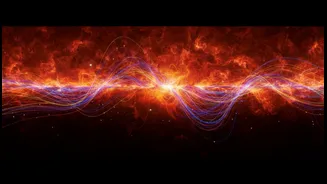
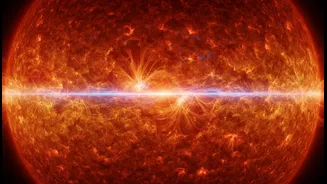
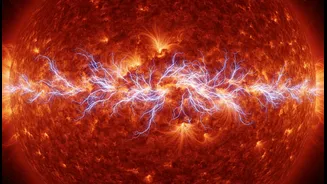
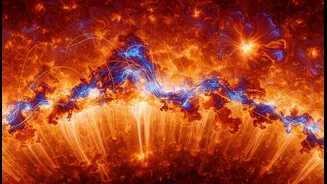
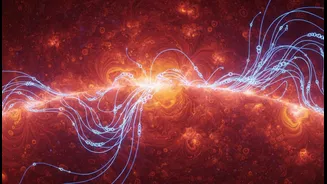
This intense shearing action is precisely why the tachocline is so important. Many scientists believe it is the seat of the solar dynamo, the process that generates the Sun’s massive magnetic field. Think of it as a cosmic generator. The differential rotation in the tachocline takes weak, north-south magnetic field lines (poloidal fields) and stretches and winds them around the Sun, amplifying them into powerful, east-west bands of magnetic flux (toroidal fields). It is these powerful magnetic ropes that form the foundation for much of the Sun's activity. Without the unique conditions in the tachocline, the Sun's magnetic field might not have the structure and strength needed to produce the solar cycle we observe.
Peering Inside a Star with Computers
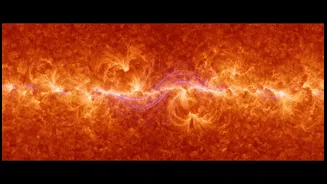
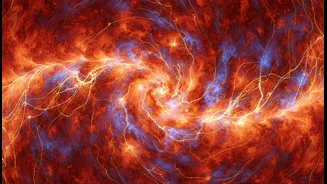
Studying a region hundreds of thousands of kilometres beneath the surface of a star is, to put it mildly, a challenge. We cannot see it directly. This is where supercomputers and sophisticated simulations come in. Scientists build virtual models of the Sun's interior, programming in the laws of physics that govern how superheated plasma, magnetic fields, and powerful flows interact—a field known as magnetohydrodynamics (MHD). By running these complex simulations, researchers can test different theories about the tachocline. They can see how a magnetic field might behave under such intense shear, or how flows of plasma confine the magnetic energy, preventing it from spreading out and weakening. These simulations are like a digital laboratory for astrophysicists, allowing them to experiment with a star.
Containing the Power
One of the key questions simulations are helping to answer is why the tachocline is so thin and well-defined. Logic suggests such a high-shear zone should spread out over time, but it remains sharply confined. Recent simulations show that magnetic fields likely play a crucial role in this confinement. The interaction between the plasma flows and magnetic fields creates a kind of magnetic cage, forcing the shear to remain within this narrow layer. This confinement is critical. It allows the magnetic field to be amplified to immense strengths. If the magnetic field were allowed to leak out or the shear layer to broaden, the solar dynamo would likely be far less efficient, resulting in a very different, and perhaps less active, Sun.
Why the Tachocline Matters on Earth
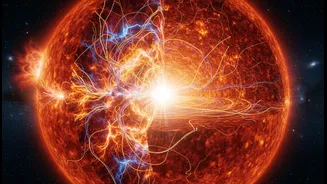
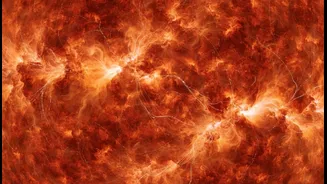
This might all sound like distant astrophysics, but the tachocline's activity has direct consequences for us. The powerful magnetic fields generated and stored there don't stay put. They eventually become buoyant and rise through the convection zone to the surface, creating sunspots. These sunspots are the launchpads for solar flares and coronal mass ejections (CMEs)—colossal eruptions that blast radiation and magnetized plasma into space. When aimed at Earth, this 'space weather' can be disruptive. It can endanger astronauts, damage satellites, disrupt GPS and communication signals, and in extreme cases, overload power grids, causing widespread blackouts. Understanding the tachocline is the first step in better predicting the solar cycle and the space weather it generates, giving us a vital early warning system for protecting our increasingly technology-dependent world.