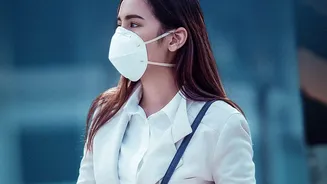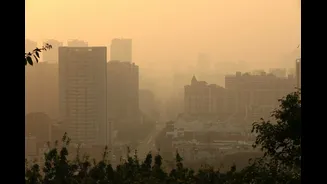







As Diwali approaches, the familiar haze of celebration fills the air. The natural instinct for many urban residents is to shut the doors and windows, creating a safe haven from the smog. But is your home truly the sanctuary you believe it to be?
The Great Indoors Isn't Always So Great
The common
assumption is that once you're inside, you're protected from the post-celebration air pollution. While closing windows does help, it's far from a foolproof solution. Research and air quality data show that indoor air can become nearly as polluted as the air outside, and sometimes even worse. Harmful microscopic particles, particularly PM2.5 (particulate matter smaller than 2.5 micrometres), are the primary culprits. These particles are released in huge quantities from firecrackers and can easily make their way indoors, posing significant health risks. Simply shutting the door doesn't create an impenetrable barrier.
How Outdoor Pollution Sneaks Inside
Fine particulate matter from firecracker smoke is tiny enough to infiltrate homes through numerous pathways. The most obvious are ventilation gaps—the small cracks around window frames and under doors that you might not even notice. Every time a door opens to welcome guests or to step out onto a balcony, a cloud of polluted air can enter. These particles can also be carried inside on clothes and shoes. Without active filtration or ventilation, these pollutants don't just disappear; they linger, suspended in the air or settling on surfaces, contributing to poor indoor air quality long after the outdoor smoke has visibly cleared.
The Pollutants We Generate Ourselves
Diwali celebrations also generate their own unique mix of indoor pollutants. The lighting of numerous diyas and agarbattis (incense sticks), while culturally significant, releases smoke and fine particles directly into your living space. Festive cooking, especially the high-heat frying of special treats, is another major source of indoor particulate matter. When these indoor sources are combined with the pollutants infiltrating from outside, the air quality inside can deteriorate rapidly. In a poorly ventilated home, the concentration of these harmful substances can build up to dangerous levels.
Understanding the Indoor/Outdoor (I/O) Ratio
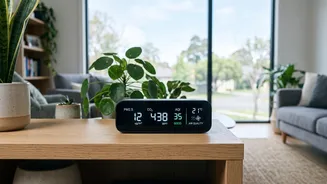
Air quality experts often use the Indoor/Outdoor (I/O) ratio to understand the relationship between pollution inside and outside a building. An I/O ratio of 1 means the concentration of a pollutant (like PM2.5) is the same indoors as it is outdoors. A ratio less than 1 suggests the building offers some protection. During heavy pollution events like Diwali, the goal is to keep this ratio as low as possible. However, studies show that in residential homes without advanced filtration, the I/O ratio can approach 1, meaning you are breathing in nearly the same polluted air inside as you would be outside. Monitoring this can reveal just how effective your protective measures are.
Health Risks of Poor Indoor Air
The health implications of breathing in high concentrations of PM2.5 are well documented. These tiny particles can penetrate deep into the lungs and even enter the bloodstream. Short term exposure can trigger coughing, irritate the respiratory system, and worsen conditions like asthma and COPD. For vulnerable populations—including children, the elderly, and individuals with pre existing heart or lung disease—the risks are even greater, with potential links to heart attacks and strokes. Because people spend the majority of their time indoors, especially during high pollution days, ensuring clean indoor air is critical for protecting your family's health.
Practical Steps for a Healthier Home
Taking control of your indoor air quality is achievable. The most effective tool is a high quality air purifier with a HEPA filter, which is designed to capture fine and ultrafine particles. Running purifiers continuously in bedrooms and living areas can significantly reduce indoor pollution levels. It is also important to ventilate strategically; keep windows closed during peak pollution hours (usually late evening and early morning) and open them for cross ventilation when the outdoor air quality improves. Use kitchen and bathroom exhaust fans to remove fumes at the source. Finally, consider limiting the use of incense and dhoop in enclosed spaces to reduce the indoor pollution load.