



The Cosmic Speed Limit
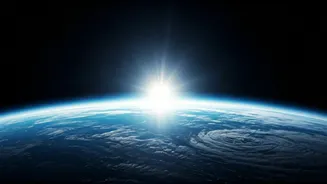
The reason for this delay is simple, yet mind-boggling: distance and the universal speed limit. The Sun is, on average, about 150 million kilometres away from Earth. Nothing in the universe can travel faster than light, which clocks in at a staggering
299,792 kilometres per second. When you do the maths (distance divided by speed), you find that it takes sunlight approximately 500 seconds to complete its journey to us. That translates to about 8 minutes and 20 seconds. So, every sunrise we witness is technically an event that happened over eight minutes in the past. We are always seeing the Sun not as it is, but as it was.
What If the Sun Vanished?
This time lag has a rather dramatic implication. If the Sun were to suddenly and mysteriously disappear, we wouldn't know it for eight full minutes. For that period, Earth would continue to orbit a ghost, and the sky would remain bright. Only after the last photons—the particles of light and heat—completed their final journey would our planet be plunged into darkness and begin to drift off into space. It’s a slightly unnerving thought experiment that perfectly illustrates this cosmic delay. We are perpetually living in the Sun's recent past.
The Real Journey Is Much Longer
While eight minutes sounds like a long commute, it’s nothing compared to the journey that energy takes just to escape the Sun itself. The 'heat elements' or photons we receive begin their life in the Sun's core, a super-dense, super-hot environment where nuclear fusion smashes hydrogen atoms together to create helium, releasing enormous energy. A photon created in the core doesn't just fly straight out. Instead, it’s absorbed and re-emitted by countless atoms in a chaotic, zigzagging path known as a 'random walk'. This journey from the core to the Sun's visible surface (the photosphere) can take an astonishingly long time—estimates range from 10,000 to over 170,000 years. The sunlight warming your face today could have been created before human civilisation began.
From the Surface to Your Skin
Once a photon finally breaks free from the Sun’s surface, its journey becomes straightforward. It travels in a straight line through the vacuum of space, unimpeded, until it strikes something. For a tiny fraction of these photons, that 'something' is Earth. When these particles strike our atmosphere, our oceans, the leaves of trees, or our skin, they transfer their energy. We perceive this transfer as light and feel it as heat. So, the 'solar heat element' mentioned in the headline is a photon, a tiny packet of energy that has travelled for millennia inside the Sun and then for eight minutes across space just to end its existence by warming a tiny patch of our world.
A Window to the Past
This principle doesn't just apply to the Sun. Because of the finite speed of light, all astronomy is a form of time travel. When we look at Proxima Centauri, the nearest star to our solar system, we are seeing it as it was over four years ago. When we gaze at the Andromeda Galaxy, we are looking at light that is 2.5 million years old. The Sun is simply our closest and most immediate example of this fundamental truth. Every ray of light is a message from the past, telling us what the universe was like moments, years, or millennia ago.