



When Galaxies Go Into Overdrive
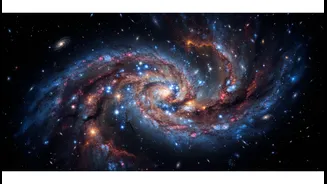
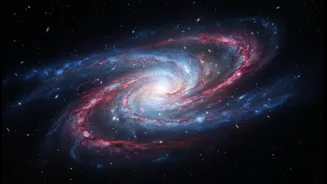
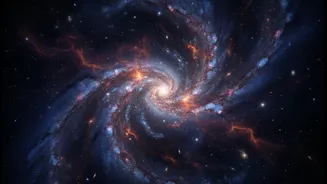
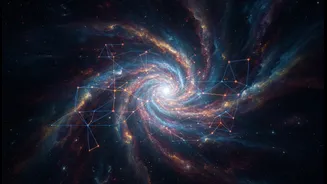
A galaxy is typically a fairly orderly place, with stars forming at a relatively steady rate. But sometimes, a galaxy goes into overdrive. This is a starburst phase, an intense and comparatively brief period where the rate of star formation can increase
by more than twenty times that of our own Milky Way galaxy. This happens when a huge amount of cool gas, the raw material for making stars, becomes compressed. Think of it like squeezing a sponge full of water. The compression triggers a massive wave of new stars being born all at once. For a long time, astronomers have linked these dramatic starburst events to equally dramatic triggers, like the collision of two galaxies.
The Violence of a Galactic Merger
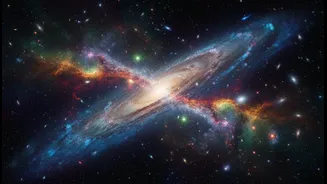
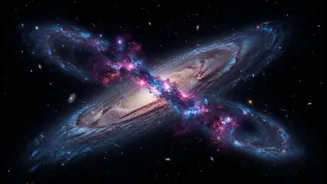
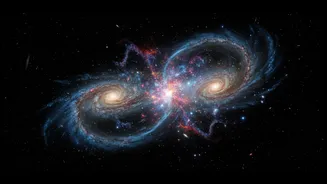
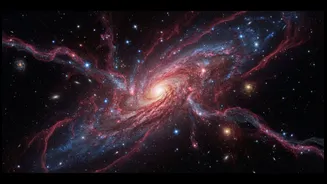
When galaxies collide, it is not like a car crash where things are instantly destroyed. Instead, it is a slow, gravitational dance that can take hundreds of millions of years. As two galaxies draw closer, their mutual gravity distorts their shapes, pulling out long streams of stars and gas. This process funnels enormous quantities of gas toward the galactic centres, providing the fuel for a spectacular starburst. However, a long-standing cosmic mystery has been what happens after this initial burst. Many massive galaxies in the early universe seem to have lived fast and died young, forming stars at a furious pace and then suddenly stopping, or 'quenching'. Why did their brilliant starburst phase end so abruptly?
Webb's New, Deeper Perspective
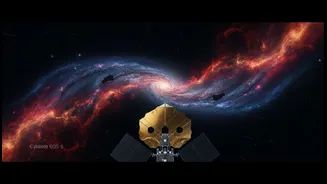
This is where the James Webb Space Telescope (JWST) changes the game. Its powerful infrared vision can peer through cosmic dust and see the faint, hidden details of distant galaxies that were previously invisible. A recent study led by astronomers at the University of Nottingham examined a selection of galaxies from about 9 billion years ago, a period known as 'cosmic noon' when star formation was at its peak across the universe. They specifically looked at 'post-starburst' galaxies—systems that had recently and rapidly shut down their star-making factories. On the surface, these galaxies looked calm and smooth. But Webb's deeper look revealed faint signs of past violence, subtle disturbances and asymmetries that point to a chaotic history.
The Mechanism of the Shutdown
The new data provides strong evidence that violent mergers are the culprits behind this rapid quenching. The same collision that triggers the initial starburst also sets the stage for its demise. The intense burst of star formation creates massive, short-lived stars that explode as powerful supernovae. These explosions, combined with the energy released by the supermassive black hole at the galaxy's centre (which is also feeding furiously on the inflowing gas), create a 'galaxy-killing' wind. This is an enormous, high-speed outflow of gas that blasts the remaining star-forming fuel out of the galaxy entirely. Without this raw material, the starburst is effectively starved into submission, and the galaxy quickly becomes 'quenched' or dead. The evidence shows that these galaxies are often left in a remarkably compact state after the event, another tell-tale sign of a violent merger.
A Tale of Two Quenching Paths
Interestingly, this violent merger scenario seems to be the primary way that massive galaxies died in the early, dense universe. The Webb data suggests a second, gentler path for smaller galaxies in the more recent universe. These systems appear to shut down their star formation more slowly, without the same disruptive transformation. This discovery helps explain the variety of galaxies we see today. The massive, compact, and spheroidal galaxies left behind by these ancient violent mergers are believed to be the ancestors of the giant elliptical galaxies that dominate galaxy clusters in the modern cosmos. By understanding their violent origins, we are piecing together the life cycle of galaxies across billions of years of cosmic history.