



An Ocean World Hiding in Plain Sight
For decades, scientists have been captivated by Europa. Slightly smaller than Earth's moon, its surface is the smoothest of any solid body in our solar system, crisscrossed by mysterious cracks and reddish-brown streaks. Strong evidence suggests that
beneath this icy shell, which could be 15 to 25 kilometers thick, lies a vast, salty ocean of liquid water. It's estimated this hidden ocean may contain more than twice the amount of water found in all of Earth's oceans combined. This immense reservoir, kept from freezing solid by the constant gravitational tug-of-war with Jupiter that generates internal heat, makes Europa one of the most promising places to search for life beyond Earth. The main ingredients for life as we know it—water, chemistry, and energy—may all be present.
The Europa Clipper: A Robotic Investigator
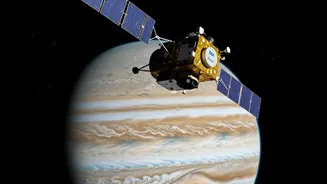
Finding out if Europa is truly habitable requires a dedicated observer. Enter the Europa Clipper spacecraft. Launched on October 14, 2024, this car-sized probe is on a long and winding path to Jupiter, scheduled to arrive in April 2030. Instead of orbiting Europa directly—which would expose it to Jupiter's intense and damaging radiation—Clipper will enter a long, looping orbit around Jupiter. From there, it will perform nearly 50 close flybys of Europa, some as low as 25 kilometers above the surface, gathering detailed measurements. This strategy allows the spacecraft to study the moon in detail while staying out of the most hazardous radiation zones for most of its mission. Its electronics are further protected inside a 9-millimeter-thick aluminum vault.
A Toolkit for Uncovering Secrets
To achieve its goals, Europa Clipper carries a suite of nine advanced scientific instruments designed to work together. An ice-penetrating radar called REASON will act like a geological sonar, probing the ice shell to confirm the ocean's existence and measure the shell's thickness. Spectrometers, like MISE and Europa-UVS, will analyze the surface composition by studying reflected infrared and ultraviolet light, searching for salts, organic molecules, and other chemical clues about the ocean below. A thermal imager will scan for hotspots, which could indicate recent eruptions of warmer water. The mission also has tools to 'taste' the environment. If Europa is venting water vapor into space through plumes, as some observations suggest, a mass spectrometer named MASPEX will fly through them to analyze their chemical makeup directly, searching for the building blocks of life.
Searching for Habitability, Not Life Itself
It’s a critical distinction to make: Europa Clipper is not designed to find life. Instead, its main objective is to determine if Europa possesses habitable environments. The mission is essentially a scientific reconnaissance, assessing whether the key ingredients and conditions for life are present. A magnetometer will measure the strength and direction of Europa's magnetic field, which can reveal the depth and saltiness of the ocean. The spacecraft’s instruments will collectively paint a picture of Europa's geology, chemistry, and the interaction between its surface and the ocean below. By understanding the moon's ice shell, the properties of its ocean, and the chemistry of its surface, scientists can build a comprehensive model of this ocean world.