



What is Nordic Walking?
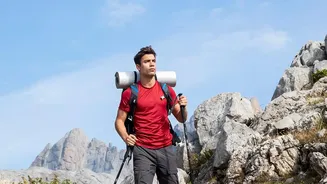
Originally developed in Finland as a summer training method for cross-country skiers, Nordic walking transforms a regular walk into a full-body exercise. It involves using specially designed poles to propel yourself forward, engaging your upper body,
arms, and core in a way that regular walking doesn't. Unlike hiking, where poles are often used for stability, Nordic walking poles are used to create forward momentum, turning your walk into a more dynamic and effective workout. The result is a low-impact activity that combines cardiovascular exercise with muscle toning for a surprisingly comprehensive fitness routine.
The Full-Body Benefits
The reason for Nordic walking's revival lies in its extensive, science-backed benefits. By recruiting muscles in the shoulders, arms, and torso, it engages up to 90% of your body's muscles, compared to about 50% with standard walking. This increased muscle activation leads to a significant boost in calorie burn—studies show it can be anywhere from 18% to 67% higher than walking without poles. Furthermore, the use of poles reduces stress on lower body joints like the knees and hips, making it an excellent option for those seeking a low-impact exercise. Research also links it to improved heart health, better balance, reduced chronic pain, and enhanced mood.
Getting the Form Right
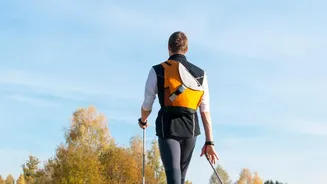
Proper technique is essential to unlock the full benefits and is surprisingly intuitive. The core movement is an enhancement of your natural walking stride. You walk with a cross-lateral motion: as your right foot steps forward, your left arm swings forward, and vice versa. The key is to plant the pole on the ground midway through your stride, between your front and back foot. As you step past the pole, you push off with your arm straight, propelling your body forward. Maintain a relaxed grip, an upright posture, and keep your gaze forward, not down at your feet. Your movements should be fluid and rhythmic rather than stiff and forceful.
Choosing Your Gear
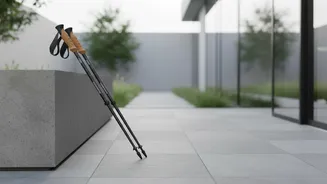
While you can walk in any comfortable athletic shoes, the one piece of essential equipment is a pair of Nordic walking poles. These are different from hiking or trekking poles. They are typically lighter and have a specific glove-like strap system that allows you to push off without maintaining a tight grip. The pole's length is also crucial; a common formula is your height in centimeters multiplied by 0.68. Many poles are adjustable, which is great for beginners. Look for poles made with some carbon content, as this helps absorb vibration and reduces strain on your joints compared to pure aluminum poles.
Common Beginner Mistakes to Avoid
As with any new skill, there are a few common hurdles for beginners. One is moving the arm and leg on the same side together, known as pacing. If this happens, try dropping your hands from the pole grips and letting the poles drag behind you by the straps as you walk normally to reset your natural rhythm. Another frequent error is planting the pole too far in front of the body, which acts as a brake instead of a propeller. Remember to plant the pole between your feet. Also, avoid using a tense, clenched grip or bending your elbows too much; the power should come from pushing back with a straight arm from the shoulder.