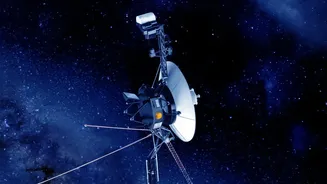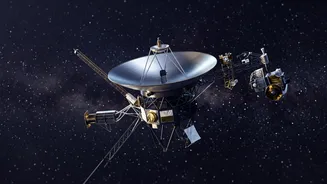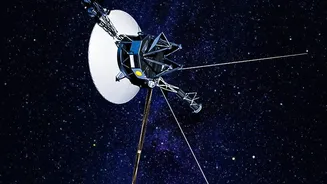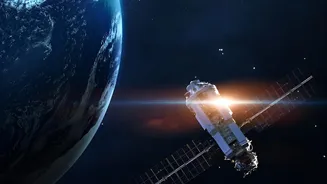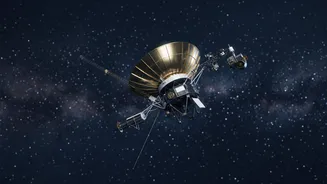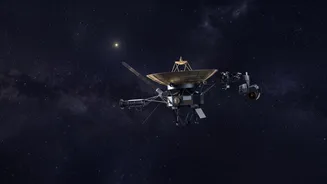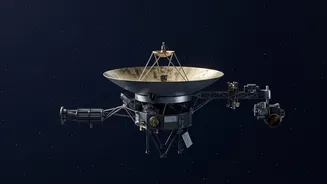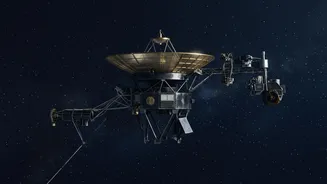




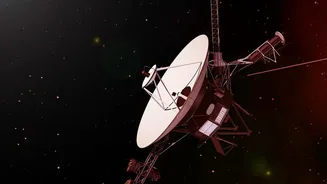
On November 18, 2026, a tiny, aging spacecraft will achieve something unprecedented. After nearly 50 years of flight, NASA's Voyager 1 will be a full light-day from Earth, a testament to human ingenuity against the vastness of space.
A Journey Measured in Light
A light-day isn't
a measure of time, but of immense distance: it's how far light travels in 24 hours, approximately 25.9 billion kilometres. To put that into perspective, light from our Sun takes just over eight minutes to reach Earth. On November 18, Voyager 1 will be so far away that a radio signal, traveling at the speed of light, will take a full 24 hours to reach it. Any response from the probe would require another 24 hours to travel back, meaning a simple 'hello' and its reply will involve a two-day wait. This milestone highlights the incredible scale of Voyager's journey and the profound challenges of communicating across interstellar distances.
A Mission for the Ages
Launched on September 5, 1977, Voyager 1 was part of a bold program to explore the outer solar system. Its original five-year mission was to study Jupiter and Saturn, taking advantage of a rare planetary alignment. It flew past Jupiter in 1979 and Saturn in 1980, making stunning discoveries, including active volcanoes on Jupiter's moon Io and the complexities of Saturn's rings. Its primary mission complete, Voyager 1's trajectory sent it hurtling out of the plane of the solar system, toward the stars. In August 2012, it officially entered interstellar space, becoming the first human-made object to cross the heliopause—the protective bubble of particles and magnetic fields created by our Sun.
Keeping a Long-Distance Call Alive
Communicating with a probe built in the 1970s from billions of kilometres away is a monumental task. NASA's Deep Space Network, a global array of massive radio antennas, strains to pick up Voyager's faint signal, which is weaker than a refrigerator light bulb. The mission has faced numerous age-related challenges. In late 2023, a memory chip failure caused the probe to send back garbled data for months before engineers devised a brilliant long-distance software fix. More recently, in October 2026, the spacecraft went silent for 48 hours before its signal mysteriously returned, an event engineers are still investigating. These incidents underscore the fragility and resilience of a mission operating far beyond its intended lifespan.
A Message in a Cosmic Bottle
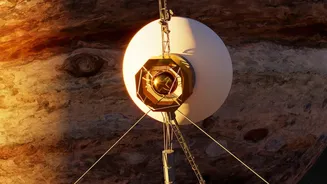
Beyond its scientific instruments, Voyager 1 carries a message from humanity to the cosmos. Affixed to its side is the Golden Record, a gold-plated copper disc containing sounds and images selected to portray the diversity of life and culture on Earth. It includes greetings in 55 languages, music from Bach to Chuck Berry, and 115 images of our world. It was a cultural time capsule, a gesture of hope and curiosity sent out into the galactic ocean. The probe is also responsible for one of the most iconic images in history: the 'Pale Blue Dot', a photograph taken in 1990 showing Earth as a tiny speck in the vastness of space, a humbling reminder of our place in the universe.
The Long Goodbye
Voyager $is$ powered by radioisotope thermoelectric generators, which have been steadily losing power for decades. To prolong the mission, engineers have been systematically shutting down non$-essential$ systems and instruments. Despite these efforts, NASA anticipates that the probe will likely fall completely silent sometime in the $2030s$, no longer able to power its transmitter. After that,$ its journey will continue in silence. It is heading in the general direction of a star named Gliese $445$, but it won'$t get close for another $40$,$000$ years. Having traveled for nearly $50$ years to cover one light$-day,$ it would take the probe around $18$,$000$ years to travel a single light$-year.