




What is a Voice Workflow?
A voice workflow isn't about a single piece of technology, but rather an ecosystem of tools that allows an editor to use their voice as the primary input for their work. This goes far beyond simple dictation. It involves using highly accurate AI to transcribe
interviews in minutes, speaking commands to edit video and audio, and dictating first drafts of articles without ever touching a keyboard. People speak, on average, three to five times faster than they can type. For professionals paid to process large amounts of information and text, this speed advantage is transformative. The goal is to separate the initial, rapid creation of content (drafting, logging) from the slower, more deliberate act of refining and polishing. In this mode, the voice is for volume and speed, while the keyboard remains for precision.
The Technology Driving the Shift
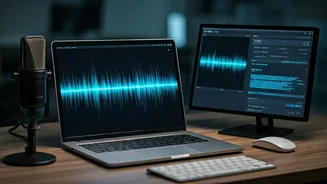
This move toward voice is powered by significant advancements in artificial intelligence and speech recognition. Tools like Otter.ai, Trint, and Descript can now produce near-instantaneous, highly accurate transcripts of audio and video files, complete with speaker identification. This has revolutionized the work of journalists and documentary editors, who once spent countless hours manually transcribing interviews. For video editors, platforms like Descript allow them to edit video by simply editing the text transcript. Deleting a sentence in the text automatically cuts the corresponding video clip, a seamless integration that was science fiction just a few years ago. Even standard operating systems now include powerful on-device dictation that works across any application, from email to content management systems.
From Speed to Accessibility
The most obvious benefit of a voice workflow is speed. For journalists on a tight deadline, dictating an article can be three times faster than typing. But the advantages go deeper. For many editors, long hours at a keyboard lead to repetitive strain injuries (RSI), wrist pain, and other physical ailments. Voice workflows offer a powerful ergonomic alternative, reducing physical strain and promoting long-term health. Furthermore, these tools have opened up the editing profession to individuals with physical disabilities that may prevent them from using a traditional keyboard and mouse setup. By making the work less physically demanding, voice technology fosters a more inclusive and accessible industry. It allows experienced editors to remain productive and helps a new generation avoid the physical tolls of the job.
The Challenges and Learning Curve
Despite the benefits, the transition isn't without friction. Voice workflows require a new set of habits. Editors must learn to 'think aloud' and structure their thoughts for dictation, which can feel unnatural at first. Background noise can interfere with accuracy, making a quiet environment essential. Early-generation dictation software often stumbled on accents, jargon, or rapid speech, leading to frustrating errors that required manual correction. While modern AI has vastly improved, no system is perfect. There's still a need for human oversight to catch misinterpretations or the dreaded AI 'hallucination'—where the system confidently inserts incorrect information. This means editors aren't being replaced by AI, but their role is shifting toward verification and refinement.
A More Conversational Future
Adopting a voice workflow does more than just change an editor's process; it can change the output itself. Many writers and editors find that dictating content leads to a more natural, conversational tone. When you speak your ideas instead of typing them, the language often becomes more fluid and authentic, which is a highly valued trait in digital media. This shift from a purely visual task to a partially auditory one requires a different kind of focus, one that is more attuned to the rhythm and flow of language. As AI continues to become more integrated into the creative process, the ability to work fluidly with voice-based tools is becoming less of a novelty and more of a core competency.