
Decoding the Sun's Breath
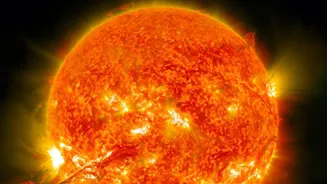
Imagine a constant, powerful wind blowing outwards from the Sun, not of air, but of superheated plasma—a stream of charged particles like protons and electrons. This is the solar wind. It races through the solar system at incredible speeds, ranging from 400
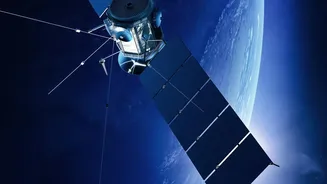
to 800 kilometres per second. This solar outflow is a fundamental force shaping the space environment around Earth and beyond. Understanding its properties is a primary goal for solar physicists, and India's Aditya-L1 mission is specifically designed to provide unprecedented details about this phenomenon.
A Strategic Perch in Space
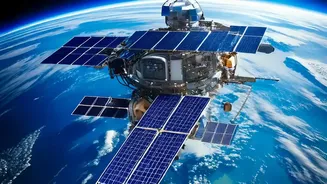
To study this wind without interruption, Aditya-L1 is positioned at a special spot 1.5 million kilometres from Earth, known as Lagrange Point 1 (L1). Here, the gravitational pulls of the Sun and Earth balance out, allowing the spacecraft to maintain a stable position. This gives it a continuous, unobscured view of the Sun and allows its instruments to directly sample the solar wind as it flows past. This in-situ measurement is crucial for understanding the wind's properties before it interacts with Earth's magnetic field.
The Heart of the Discovery: A Turbulent Wind
The latest data from Aditya-L1's sensors, particularly the Aditya Solar wind Particle Experiment (ASPEX) and the Plasma Analyser Package for Aditya (PAPA), confirm that the solar wind is far from a smooth, steady stream. Its velocity fluctuates, showing signs of turbulence, much like a gusty day on Earth. The ASPEX payload, which includes the Solar Wind Ion Spectrometer (SWIS), measures the direction, speed, and density of solar wind ions. These instruments have been capturing variations in the counts of protons and alpha particles, providing a high-resolution snapshot of the wind's behaviour. A scientific paper assessing the first year of SWIS operations confirmed the instrument's ability to capture these dynamic features, noting that its analysis revealed a spectral slope consistent with magnetohydrodynamic turbulence.
Why These Fluctuations Matter
Mapping these velocity fluctuations isn't just an academic exercise; it has significant real-world implications. The turbulence in the solar wind is a key driver of space weather. Sudden changes in the wind's speed, density, and embedded magnetic field can trigger geomagnetic storms on Earth. These storms can disrupt satellite communications, damage power grids, interfere with GPS navigation, and pose a radiation hazard to astronauts. By understanding the nature of these fluctuations, scientists can build more accurate models to forecast space weather. For example, a change in the ratio of alpha particles to protons can be a sensitive marker for an incoming Coronal Mass Ejection (CME), a massive eruption of solar material. Better forecasting gives us more time to protect our critical technological infrastructure.
A Milestone for Indian Science
The data on solar wind fluctuations is a testament to the success of Aditya-L1's in-situ instruments. Payloads like ASPEX and PAPA, developed by the Physical Research Laboratory and Vikram Sarabhai Space Centre respectively, are performing nominally and delivering high-quality scientific data. These findings not only prove the capabilities of Indian space technology but also contribute vital information to the global scientific community. By providing continuous, detailed measurements from the L1 point, Aditya-L1 is helping to fill crucial gaps in our understanding of the Sun-Earth connection. The mission is a significant milestone for ISRO, marking India's arrival as a key player in heliophysics research.