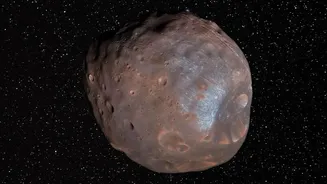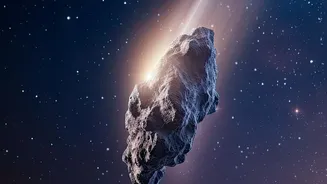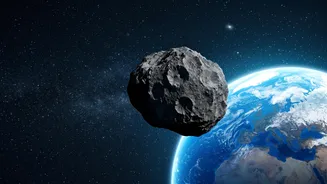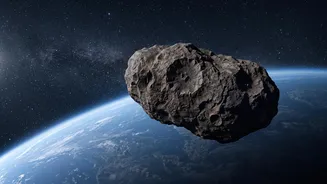





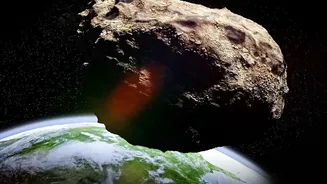
It turns out our Moon isn't always our only natural satellite. Earth is currently hosting a temporary visitor, a tiny 'mini-moon' designated 2026 QQ8. But don't get too attached—its stay is short-lived, and it's due to depart soon.
Meet Our Temporary Companion, 2026 QQ8
Earth has a new, albeit
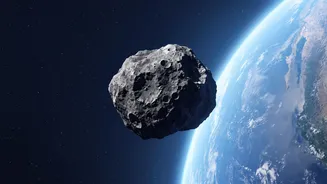
temporary, celestial partner. A small asteroid named 2026 QQ8, only about two metres across, was captured by our planet's gravity back in April 2026. First spotted in August by Hungarian astronomer Krisztián Sárneczky, it took weeks of observation to confirm that the faint object was a natural space rock and not a piece of a defunct satellite. In late October 2026, the International Astronomical Union's Minor Planet Center gave it its official name. Astronomers predict that this mini-moon will continue to orbit Earth until about January 2027, when it will break free from our planet's gravitational pull.
What Exactly Is a 'Mini-Moon'?
A mini-moon is not an official astronomical term, but a nickname for a small asteroid or meteoroid that is temporarily captured by a planet's gravity. These objects, often called Temporarily Captured Objects (TCOs), enter a chaotic and unstable orbit around Earth for a short period—from a few months to a few years—before being flung back out into an orbit around the Sun. This happens when a Near-Earth Object (NEO) approaches our planet at a relatively low speed, allowing it to be gently pulled into what is known as Earth's Hill sphere—a region where our planet's gravity is dominant over the Sun's.
The Delicate Gravitational Dance
The journey of a mini-moon is a complex gravitational ballet. For an object to be captured, it needs to enter Earth's sphere of influence with just the right speed and trajectory. Most NEOs that pass by are moving too fast and just fly past us. But if an asteroid's orbit is very similar to Earth's, its relative speed can be low enough for capture. Once caught, its path becomes unstable, constantly perturbed by the gravitational forces of Earth, our main Moon, and the Sun. These interactions mean that after a few orbits, the object is inevitably ejected, returning to its life as an asteroid orbiting the Sun. 2026 QQ8's departure is expected around January 2027.
Are These Visitors Common?
While officially confirmed mini-moons are rare, studies suggest they are actually quite common. According to simulations, Earth may have at least one mini-moon with a diameter of about one metre at any given time. However, their small size and faintness make them incredibly difficult to detect with current survey telescopes. Before 2026 QQ8, other notable temporary moons included 2006 RH120, which orbited Earth for about a year, and 2020 CD3, which stayed for nearly three years. The discovery of 2026 QQ8, which is larger than the average mini-moon, happens only about once every 10 to 20 years.
Why Scientists Study These Fleeting Moons
Studying mini-moons offers a unique and valuable scientific opportunity. These objects are essentially free samples of asteroids delivered right to our doorstep. Because they come so close, they are easier to study than asteroids in the main belt between Mars and Jupiter. Observations of mini-moons can provide insights into the composition and properties of near-Earth asteroids, helping us understand the materials that formed our solar system. They also serve as a useful test for our planetary defense systems, which are designed to detect and track objects that could potentially pose an impact risk to Earth. Fortunately, 2026 QQ8 poses no threat; at its tiny size, it would simply burn up in the atmosphere if it ever came too close.