






A Surprise Counterpart to the Hexagon
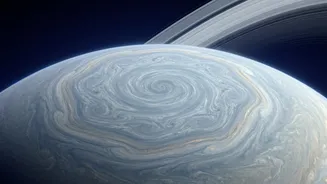
For decades, scientists have been fascinated by a massive, six-sided jet stream at Saturn's north pole, known simply as 'the hexagon'. It's a remarkably stable feature that has been observed for over 40 years. The south pole, however, was thought to be comparatively
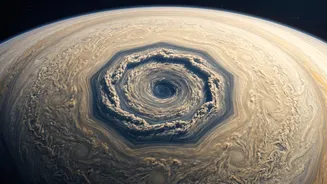
plain. That has now changed. Recent Hubble observations have revealed a giant, evolving 10-sided atmospheric wave, or 'decagon', encircling the south pole. This is the first time such a large, regular-sided jet pattern has been seen in the planet's southern hemisphere, and it appears to be a relatively new development.
A Question of Timing and Seasons
So, why are we seeing this now? It's all about a change of seasons. Like Earth, Saturn is tilted on its axis and experiences seasons, but they last much longer—each one is about seven Earth years long. For years, Saturn's southern hemisphere was tilted away from Earth, hidden from view. As Saturn continued its 29-year orbit around the Sun, its south pole gradually came back into view. This changing perspective allowed astronomers, using both ground-based observatories and Hubble, to spot the first signs of this new feature emerging. Archival data from Hubble shows hints of the structure dating back to 2023, but it has become much more distinct recently.
The Role of the Hubble OPAL Program
These observations are part of a long-term project called the Outer Planet Atmospheres Legacy (OPAL) program. Since 2014, Hubble has been taking yearly snapshots of our solar system's gas giants—Jupiter, Saturn, Uranus, and Neptune—to monitor their dynamic atmospheres over time. Because these planets are constantly changing, regular observations with the same instruments are crucial for understanding long-term trends, like seasonal shifts and the evolution of massive storms. This consistent monitoring is what allowed scientists to not only discover the new decagon but also trace its development over several years, providing a rare opportunity to watch a giant atmospheric pattern being born.
Unlocking Atmospheric Mysteries
The discovery of a southern decagon raises many questions. Scientists are intrigued by the differences between it and the northern hexagon. While the hexagon is stable, this new 10-sided pattern appears to be strengthening and evolving. Researchers have found that the pattern extends through multiple layers of Saturn's clouds, meaning it's a deep, vertically significant structure and not just a surface feature. By comparing the two poles, scientists hope to better understand the physics that create these strange geometric shapes. It could reveal fundamental insights into how jet streams and weather patterns behave on giant gas planets, both in our solar system and beyond.