


Our Turbulent Galactic Neighbor
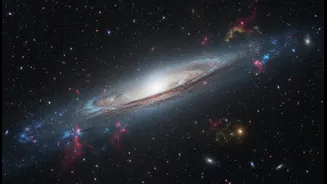
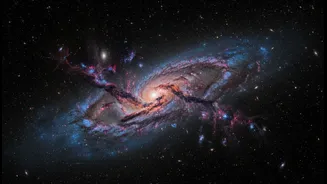
Just 11 million light-years away, Centaurus A is practically on our celestial doorstep. But it's no quiet neighbor. This galaxy is the result of a colossal smash-up between a large elliptical galaxy and a smaller spiral galaxy that occurred roughly two
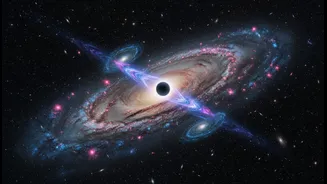
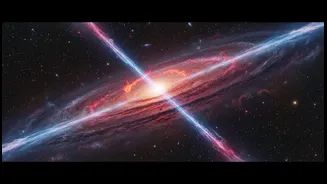
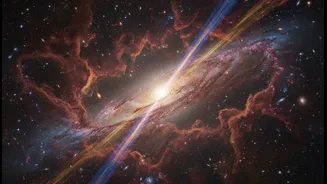
billion years ago. The chaotic aftermath of this merger has made Centaurus A a hotbed of activity. It has a strange, warped shape, crisscrossed by thick lanes of dust. At its heart lies a supermassive black hole, about 55 million times the mass of our sun, that is actively feeding on surrounding gas and dust. This cosmic engine spews out enormous jets of energy, making Centaurus A one of the brightest sources of radio waves in the sky.
Webb's Infrared Superpower
For years, astronomers have studied Centaurus A, but its dense, dark dust lanes have acted like a thick veil, hiding the galaxy's core from view. Telescopes like Hubble, which primarily see in visible light, couldn't fully penetrate the shroud. Even previous infrared observatories like Spitzer lacked the sharpness to see the fine details. This is where the James Webb Space Telescope (JWST) changes the game. Using its powerful near- and mid-infrared instruments, Webb can peer through the obscuring dust, much like an X-ray can see through skin. The result is an image of breathtaking clarity, transforming what once looked like a hazy glow into a rich, complex tapestry of stars, gas, and dust.
A Portrait of Galactic History
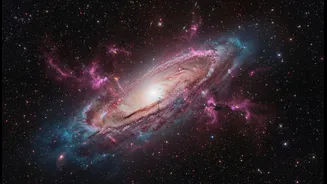
The new images, released to mark Webb's fourth year of science operations, are more than just pretty pictures; they are a historical record. For the first time, astronomers can resolve millions of individual stars within the galaxy's turbulent center. This is like turning on the lights in a previously dark room. By studying these stars—their age, location, and composition—scientists can perform a kind of galactic archaeology. They can piece together a timeline, identifying which stars existed before the galactic collision, which were born during the violent merger, and which have formed since. The images reveal intricate filaments and glowing clouds of warm dust, providing new clues about how the galaxy's past continues to shape its present.
The Black Hole's Creative Destruction
Webb’s view also provides an unprecedented look at the complex relationship between a supermassive black hole and its host galaxy. The black hole at the center of Centaurus A is a force of both creation and destruction. As it pulls in material, its immense gravity and energy output can compress surrounding gas, triggering bursts of new star formation. At the same time, the powerful jets it unleashes can blast material away, shutting down star formation in other areas. Webb’s observations show warm hydrogen gas rotating near the black hole while other gas rushes outward, offering a rare, close-up view of this cosmic balancing act. Understanding this interplay in Centaurus A helps scientists model how galaxies and their central black holes co-evolve across the universe.