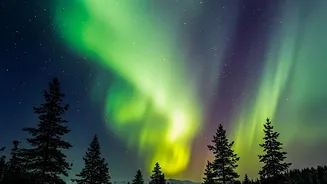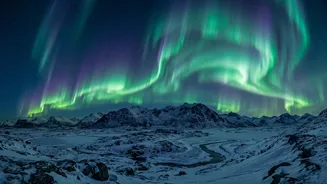



The aurora is one of nature’s most dazzling spectacles, a celestial ballet of light dancing across polar skies. For decades, scientists have known this display is linked to solar activity, but recent research has finally traced the trigger to its source.
The Dance of Celestial Light
The northern and southern lights are more than just a beautiful display; they are a visible sign of our planet’s interaction with space. They occur when energetic particles, mostly electrons, stream down from space and collide with oxygen and nitrogen atoms in Earth's upper atmosphere. These collisions excite the atmospheric gases, causing them to glow in vibrant shades of green, red, and purple. This process is driven by the solar wind, a constant stream of charged particles flowing from the sun. But the precise trigger for the most intense auroral shows, known as substorms, has been the subject of a long-standing scientific quest.
Earth’s Invisible, Stretched Tail
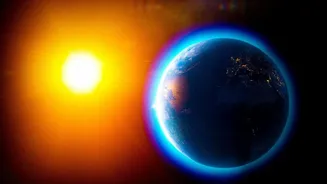
Surrounding our planet is a vast magnetic bubble called the magnetosphere, which shields us from the harshest effects of the solar wind. This magnetic field is not perfectly symmetrical. On the side facing the sun, it is compressed by the solar wind. On the night side, it is stretched out into a long, trailing region known as the magnetotail, which can extend hundreds of thousands of kilometres into space. Think of it like a windsock in the solar breeze. As energy from the solar wind builds up, the magnetotail becomes increasingly stretched and loaded with stored magnetic energy, like a rubber band being pulled taut.
A Long-Distance Connection Confirmed
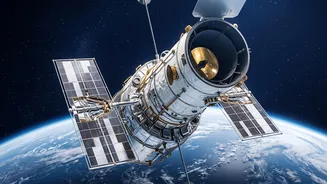
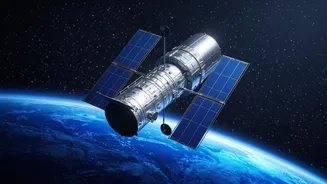
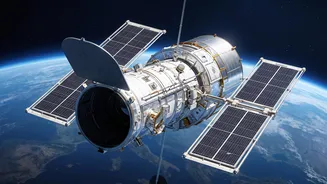
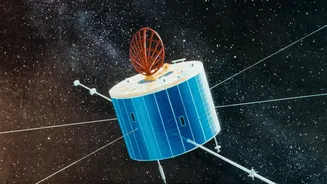
New research has provided the clearest evidence yet of what happens next. The key process is called magnetic reconnection. Far out in the magnetotail, on the dark side of Earth, the stretched magnetic field lines can suddenly snap and reconnect in an explosive event. For years, this was a leading theory, but direct observation was elusive. Using a fleet of coordinated satellites, such as NASA's THEMIS (Time History of Events and Macroscale Interactions during Substorms) mission, scientists have now been able to pinpoint this event as the trigger. They observed magnetic reconnection happening in the magnetotail and, minutes later, saw the dramatic brightening of the aurora above Earth.
Following the Energy Trail
Making this connection required a combination of spacecraft and ground_based observatories. The five THEMIS satellites were placed in specific orbits that allowed them to line up and monitor the magnetotail. When they detected the tell_tale signs of a reconnection event—an abrupt change in the magnetic field and a burst of particles—they could alert scientists. Simultaneously, a network of cameras and magnetic sensors on the ground in North America watched for changes in the aurora and the local magnetic field. The data showed a clear sequence: reconnection occurred first, followed just minutes later by auroral intensification and disturbances in Earth’s magnetic field at the surface. This confirmed that energy released tens of thousands of kilometres away is rapidly channelled along magnetic field lines toward the poles.
Why This Matters for Earth
Understanding this link is about more than just solving a cosmic mystery. The same explosive process that creates the beautiful aurora is a key component of space weather, which can have significant impacts on our technology_dependent world. The intense electrical currents generated during these events can induce currents in power grids on the ground, potentially causing blackouts, as has been seen in Sweden. These space weather substorms can also disrupt satellite communications and navigation systems like GPS. By confirming magnetic reconnection as the trigger and timing its effects on the ground, scientists can build better forecasting models. This provides a crucial early warning for power grid operators and satellite controllers, giving them time to prepare for the impacts of an incoming geomagnetic storm.