
Our Sun's Volatile Temperament
A solar flare is a tremendous explosion on the Sun's surface, releasing a burst of energy, light, and high-speed particles into space. These events are born from the Sun's complex magnetic fields, which can twist and snap like cosmic rubber bands. When
these magnetic field lines realign, they can launch vast bubbles of plasma and magnetic fields known as Coronal Mass Ejections (CMEs). These CMEs can travel outward from the Sun at speeds up to nearly 3,000 kilometres per second, carrying billions of tons of material. While many flares and CMEs are not directed at Earth, the ones that are can have significant consequences. Their frequency varies with the Sun's 11-year cycle, with several per day possible during solar maximum. Early in July 2026, the sun saw a surge in activity, with one sunspot group becoming the largest of the year and the second largest in the past decade, producing around 140 flares.
NASA's Eyes on the Sun
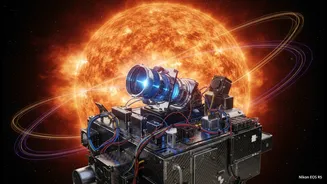
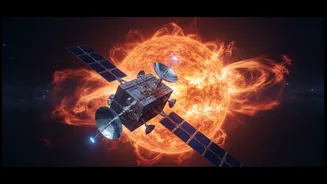
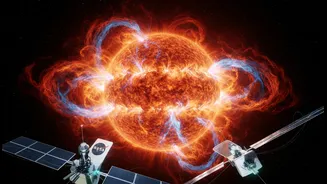
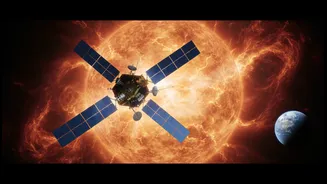
To keep tabs on this solar activity, NASA operates a fleet of dedicated spacecraft. The Solar Dynamics Observatory (SDO), launched in 2010, is a cornerstone of this effort. SDO maintains a constant, unblinking watch on the Sun, capturing high-resolution images across multiple wavelengths of light every few seconds. This allows scientists to see how the Sun's atmosphere and magnetic fields evolve, providing crucial clues about when and where a flare might erupt. Another key player is the Parker Solar Probe. This remarkable spacecraft is on a historic mission to fly through the Sun's outer atmosphere, or corona, coming closer than any probe before it. By taking direct measurements from within the birthplace of the solar wind, Parker provides invaluable data on the forces that drive solar flares and CMEs, helping to improve our forecasting models. The primary mission for Parker Solar Probe ended in 2025, but it continues its observations into 2026.
The Risk to a High-Tech World
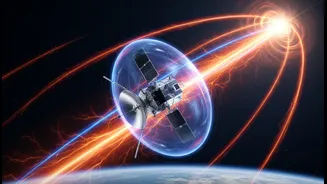
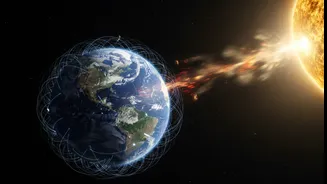
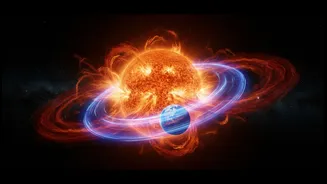
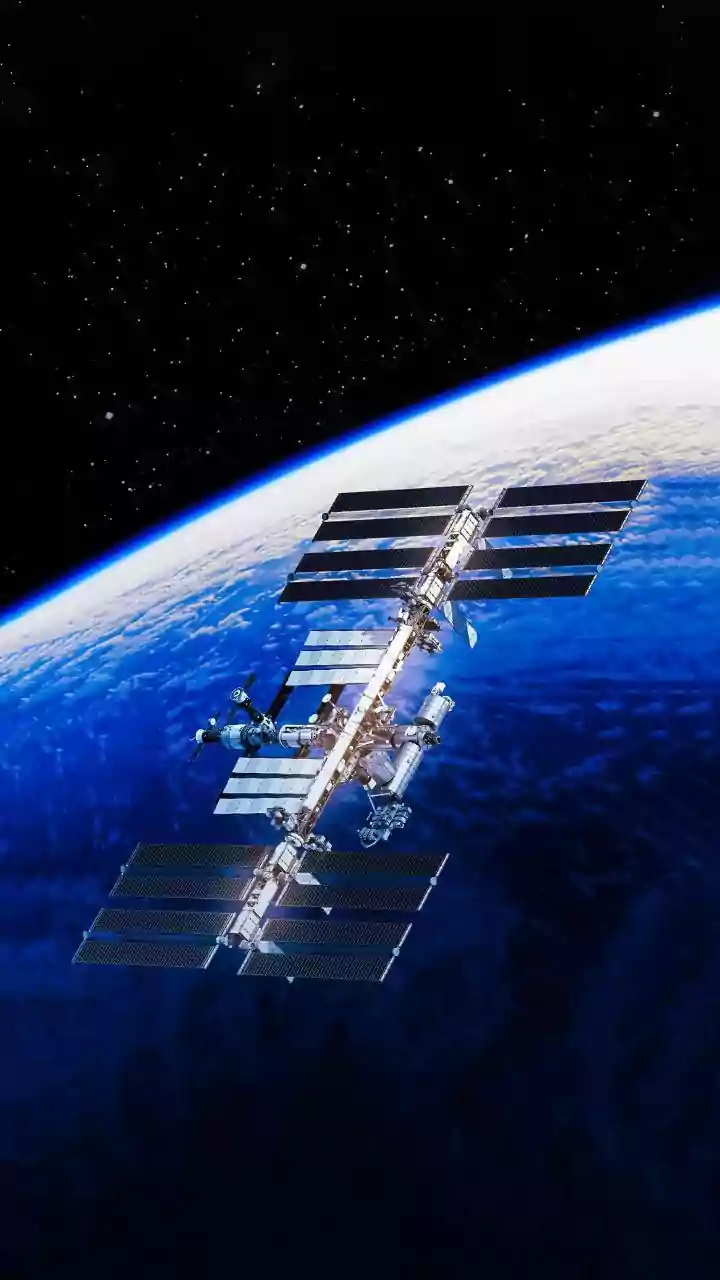
When a powerful solar event hits Earth's magnetic field, it can trigger what is known as a geomagnetic storm. For satellites in orbit, the effects can be immediate. The burst of radiation can damage sensitive electronics, essentially frying their circuits. The energy can also heat Earth's outer atmosphere, causing it to expand. This expansion increases the atmospheric drag on satellites in low-Earth orbit, slowing them down and potentially shortening their operational lifespan. Furthermore, these solar storms disrupt the ionosphere, the atmospheric layer that radio and GPS signals travel through. This interference can degrade or block communications and reduce the accuracy of GPS systems, sometimes by significant margins. This poses a risk not only to navigation apps on our phones but to critical industries like aviation, shipping, and precision agriculture that depend on exact positioning.
From Data to Defensive Action
The data collected by SDO, Parker Solar Probe, and other solar observatories is fed to agencies like NOAA's Space Weather Prediction Center, the official source for space weather forecasts in the U.S. When an Earth-directed CME is detected, these agencies issue warnings. This gives satellite operators, power grid managers, and airlines time to prepare. For a satellite, this might mean temporarily shutting down non-essential systems or reorienting the craft to protect its most sensitive components. For future crewed missions, such as those to the Moon and Mars, this advanced warning is even more critical. Astronauts outside the protection of Earth's magnetic field are more vulnerable to the high-energy particles produced by solar flares. Accurate space weather forecasting, enabled by NASA's research, is essential for ensuring their safety during deep-space travel.