




A New World Comes into Focus
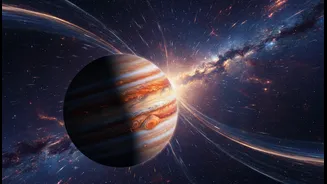
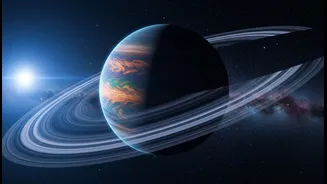
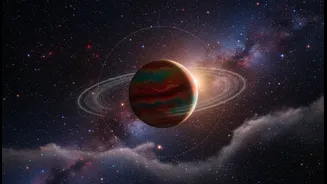
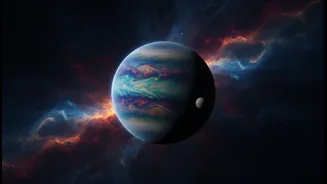
Astronomers have confirmed the existence of a massive planet named Gaia23bra b, located about 40,000 light-years from Earth. This isn't your typical exoplanet discovery. The world is a 'super-Jupiter,' with about 1.6 times the mass of our solar system's
largest planet, and it orbits its star at a distance similar to Jupiter's orbit around the sun. What makes this find remarkable is that the planet was essentially hiding in plain sight. Initial hints of its existence were flagged by the Gaia space telescope in 2023, but it took a fresh look at data from NASA's TESS satellite to confirm it was really there. This discovery showcases a powerful, if tricky, method for finding worlds that other techniques would likely miss.
Seeing the Unseen with Gravity's Lens
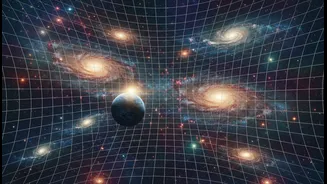
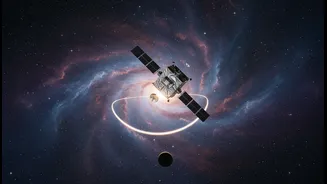
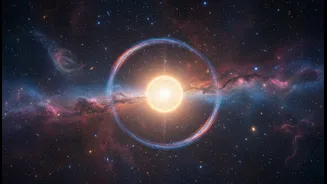
The technique responsible is called gravitational microlensing, an effect predicted by Albert Einstein's theory of general relativity. The theory states that massive objects warp the fabric of spacetime around them. When a star and its planet pass in front of a more distant background star, their combined gravity acts like a cosmic magnifying glass. This 'lens' bends and amplifies the light from the background star, causing it to temporarily brighten. If the foreground star has a planet, the planet's own gravity creates a second, smaller distortion—a brief, extra spike in the brightness. For Gaia23bra b, this tiny gravitational flicker was the telltale sign that gave it away.
A New Trick for an Old Telescope
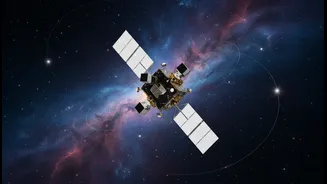
NASA's TESS spacecraft typically hunts for planets using the 'transit method,' where it looks for the slight dip in a star's light as a planet passes in front of it. This method is most effective for finding large planets orbiting very close to their stars. Gaia23bra b, being so far from its star, would likely never have been found this way. By successfully using microlensing, TESS has added a powerful new tool to its arsenal. Scientists were not initially expecting TESS to be capable of this kind of detection. This success implies that there could be many more such planets hiding in existing data, waiting to be found by astronomers who now know what to look for.
Finding the Planets Our Methods Miss
Gravitational microlensing is uniquely suited to finding planets that are otherwise invisible to us. While the transit method has discovered the vast majority of the 6,000+ known exoplanets, microlensing has accounted for less than 5 percent. However, its strength lies in what it can find: smaller, Earth-mass planets and worlds orbiting far from their parent stars, much like the planets in our own solar system. It is the only known method capable of discovering planets at truly great distances and can even detect 'rogue planets' that wander through the galaxy untethered to any star. The main drawback is that these cosmic alignments are rare, one-time events. Once the moment passes, the planet can never be observed the same way again.
A Preview of Discoveries to Come
This discovery serves as a thrilling preview of what's to come. NASA's upcoming Nancy Grace Roman Space Telescope, set to launch later this decade, will be a microlensing powerhouse. It will continuously monitor the dense star fields at the heart of the Milky Way, where microlensing events are more common. Scientists predict Roman will use this technique to discover around 1,000 new exoplanets, complementing the thousands more it will find via the transit method. Each new world discovered this way helps us build a more complete census of the galaxy's planets, bringing us closer to understanding how planetary systems form and evolve, and ultimately, how common worlds like our own might be.