




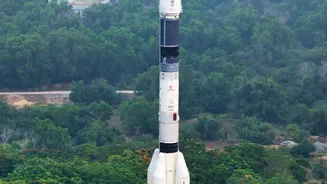
What Exactly is a Reusable Launch Vehicle?
A traditional rocket is an expendable, single-use machine. Its expensive stages are discarded during flight, burning up in the atmosphere or falling into the sea. This model is why launching anything into space is so costly; up to 80% of a launch's price
tag is tied to the vehicle itself, not the fuel. A Reusable Launch Vehicle (RLV), as the name suggests, is designed to be used again. Like an aircraft, it can fly to space, deploy a payload like a satellite, and then return to Earth for a runway landing. By recovering and reusing the most valuable parts of the rocket, the cost per launch can be slashed dramatically. ISRO's winged RLV technology demonstrator is nicknamed 'Pushpak', after the mythical flying palace from the Ramayana.
Pushpak's Recent Landing Triumphs
ISRO has been methodically testing Pushpak’s most critical technology: its ability to land on its own. In a series of three successful Landing Experiments (LEX) concluding in June 2024, ISRO proved the vehicle's autonomous capabilities. During these tests, conducted at the Aeronautical Test Range in Chitradurga, Karnataka, an Indian Air Force Chinook helicopter carried the SUV-sized Pushpak to an altitude of 4.5 kilometres. From there, it was released to find its own way back to the runway. In the final and most challenging test, Pushpak successfully corrected its course from a significant offset, battled winds, and executed a precise, high-speed landing at over 320 km/h. After touchdown, it used a brake parachute and its landing gear brakes to come to a controlled stop, proving its guidance and control systems are ready for more complex missions.
The Billion-Dollar Question: Slashing Costs
The primary goal of the RLV program is economic. By mastering reusability, ISRO aims to reduce launch costs by up to 80%, a figure that would revolutionize India's position in the global space market. Some estimates suggest the long-term goal is to bring the cost of sending one kilogram of payload to orbit down from the current $10,000-$15,000 range to as low as $1,000. This dramatic cost reduction would make space far more accessible. It opens the door for Indian startups, universities, and international clients to launch satellites more frequently and affordably. For ISRO's commercial arm, NewSpace India Limited, a reusable rocket would be a powerful asset, allowing it to compete aggressively for a larger share of the multi-billion dollar global launch industry.
More Than Just Savings
Lowering the financial barrier to space has ripple effects that go far beyond launch contracts. Affordable access to orbit enables the deployment of large satellite constellations for applications like high-speed internet, improved Earth observation, and enhanced navigation services. It also makes future ambitious projects more feasible, such as servicing or refueling satellites in orbit, retrieving them for refurbishment, or even missions to help minimize space debris. For India, this technological capability is also a matter of strategic autonomy. Having a cost-effective, sovereign launch capability reduces dependence on other nations and strengthens India's ability to pursue its own scientific, commercial, and security objectives in space, paving the way for goals like the Bharatiya Antariksh Station planned for 2035.
The Road Ahead for Pushpak
The successful landing experiments are a major milestone, but the journey is far from over. With the landing phase mastered, ISRO is now shifting its focus to the next daunting challenge: the Orbital Re-entry Experiment (OREX). This future mission will involve launching a scaled-up version of Pushpak into orbit on a rocket. After circling the Earth, it will have to survive the fiery heat of re-entry and then perform another autonomous runway landing. This will test the vehicle's thermal protection systems and its ability to handle the full mission profile. While an operational reusable rocket is still several years away, the successful LEX missions have proven that ISRO has mastered the crucial foundational technologies needed to make it a reality.