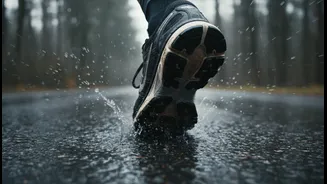









The Peril of the Slippery Slope
For many runners, especially in a place like India during monsoon season, a wet downhill is a familiar foe. Whether it's a slick paved road, a muddy trail, or mossy steps, the loss of traction is a constant worry. The natural instinct for many is to lean
back and slam on the brakes with their heels. This feels like a safe, controlling motion, but it's often counterproductive. This braking action, also known as overstriding, involves landing with your foot far out in front of your body's centre of mass. On a dry surface, this puts immense strain on your quadriceps and joints. On a wet surface, it significantly increases the chance of your foot sliding out from under you, leading to a fall and potential injury.
The Biomechanics of a Shorter Stride
The solution lies not in braking, but in changing how you step. Taking shorter, quicker steps—also known as increasing your cadence—is the key to staying upright. When you shorten your stride, your foot lands more directly underneath your body's centre of gravity. This simple change has several profound effects. First, it reduces the braking forces that cause you to skid. Instead of pushing against the slippery ground, you are placing your foot down for support. Second, it reduces the impact forces travelling up your leg to your knees and hips. Research has shown that even a 5% increase in step rate can reduce impact forces on the knee by up to 20%. This makes your run not only safer but also less stressful on your body.
Finding Your Quicker Cadence
Thinking about taking 'shorter steps' can sometimes feel unnatural or lead to a slower pace. Instead, focus on increasing your cadence, or the number of steps you take per minute. Elite runners often have a cadence of around 180 steps per minute or higher, but you don't need to hit a magic number. A good goal is to aim for a 5-10% increase from your usual cadence. You can use a metronome app on your phone or watch, or find playlists with songs at a specific beats-per-minute to help you find the rhythm. The idea is to feel like your feet are making a light, quick 'pitter-patter' on the ground rather than a heavy, stomping motion. This high turnover helps you react faster to any small slips and maintain your balance.
Putting It All Together on the Descent
When approaching a wet downhill, adjust your form proactively. Lean slightly forward from your hips, keeping your torso perpendicular to the hill. Resist the urge to lean back. Keep your knees slightly bent to act as shock absorbers. Shorten your stride and quicken your steps, aiming for that light-on-your-feet feeling. Use your arms for balance; holding them out to the side like airplane wings can significantly improve your stability. It's also crucial to scan the path a few metres ahead instead of looking directly at your feet. This allows your brain to process the terrain and plan your next few footfalls, helping you choose the path of most grip and avoid surprisingly slick spots like wet leaves or metal drain covers.