


So, What Did They Actually Find?
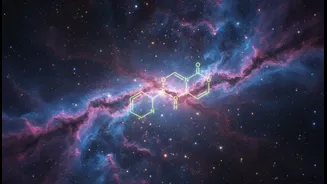
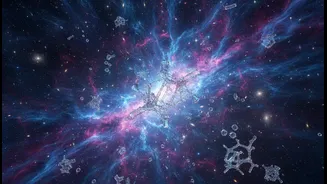
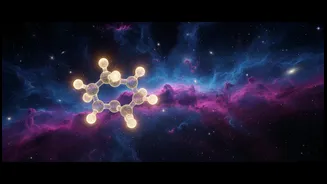
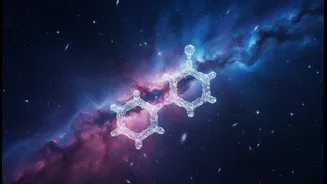
When scientists talk about finding “sugar” in space, they aren’t talking about the stuff you stir into your morning chai. They’re referring to simple organic molecules that are chemically classified as sugars. Recently, astronomers detected erythrulose,
a four-carbon sugar, in a vast cloud of gas and dust near the centre of our Milky Way galaxy. This follows earlier discoveries of other simple sugars, like the two-carbon molecule glycolaldehyde in interstellar clouds and the five-carbon sugar ribose in meteorites that have crashed on Earth. Ribose is particularly significant because it’s a key component of RNA, a molecule essential to life as we know it. These molecules are detected using powerful radio telescopes that pick up the unique energy signatures, or “fingerprints,” these molecules emit as they tumble through space.
A Cosmic Kitchen, No Chef Required
So, if there’s sugar in space, does that mean something is out there making it? The short answer is no. One of the most fascinating fields of study is prebiotic chemistry, which explores how the building blocks of life can form from non-living matter. The universe is a giant chemical laboratory. In the vast, cold clouds of gas and dust between stars, simple atoms like carbon, hydrogen, and oxygen are abundant. Blasted by radiation from nearby stars, these atoms and simple molecules can react in ways they couldn't on Earth, forming more complex structures over millions of years. Laboratory experiments have shown that molecules like formaldehyde and ammonia, which are common in space, can react under these conditions to form sugars like glycolaldehyde and, eventually, more complex ones. It’s a natural, non-biological process—cosmic chemistry at its finest.
Ingredients vs. The Fully Baked Cake
This is the most crucial distinction to understand. Finding sugar molecules in space is like finding a bag of flour and a box of sugar in a kitchen. It proves the basic ingredients are present, but it doesn’t mean a cake has been baked. Life, as we understand it, is the fully baked cake—and a very complicated one at that. It’s a self-sustaining, self-replicating system capable of metabolism and evolution. A simple sugar molecule like ribose is just one ingredient. You still need amino acids (to make proteins), lipids (to make cell membranes), and nucleobases, all assembled in an incredibly complex and specific way to form something like a living cell. Finding the ingredients is a huge step, but it’s a very long way from finding the finished product.
Then Why Is It Such A Big Deal?
If it doesn't mean aliens, you might wonder why scientists get so excited. The discovery is monumental because it confirms that the building blocks of life are not unique to Earth. For decades, scientists wondered if the emergence of life here was a one-off fluke, dependent on a unique set of circumstances. By finding these crucial prebiotic molecules in meteorites and floating in interstellar clouds, we learn that the raw materials for life are literally scattered across the galaxy. It suggests that other planets, orbiting other stars, would have been showered with the same life-starting ingredients that early Earth was. This doesn't guarantee life is out there, but it dramatically increases the odds that the process could have started elsewhere. It turns the possibility of alien life from pure speculation into a tangible scientific investigation.