



The Universe’s Ultimate Speed Limit
Everything we see is thanks to light. But light, for all its incredible speed, is not instantaneous. It travels at a blistering 300,000 kilometres per second, a velocity so immense it can circle the Earth seven and a half times in a single second. In
our day-to-day lives on a human scale, this feels like 'right now.' But space is not built on a human scale. It is vast beyond comprehension. The most relatable example is our very own Sun. It is, on average, 150 million kilometres away. The light you feel on your skin right now did not leave the Sun right now. It left approximately 8 minutes and 20 seconds ago. If the Sun were to suddenly vanish, we would continue to see it shining in the sky for over eight minutes, blissfully unaware that it was already gone. This simple fact is the key to understanding the entire night sky.
Looking Through a Time Machine
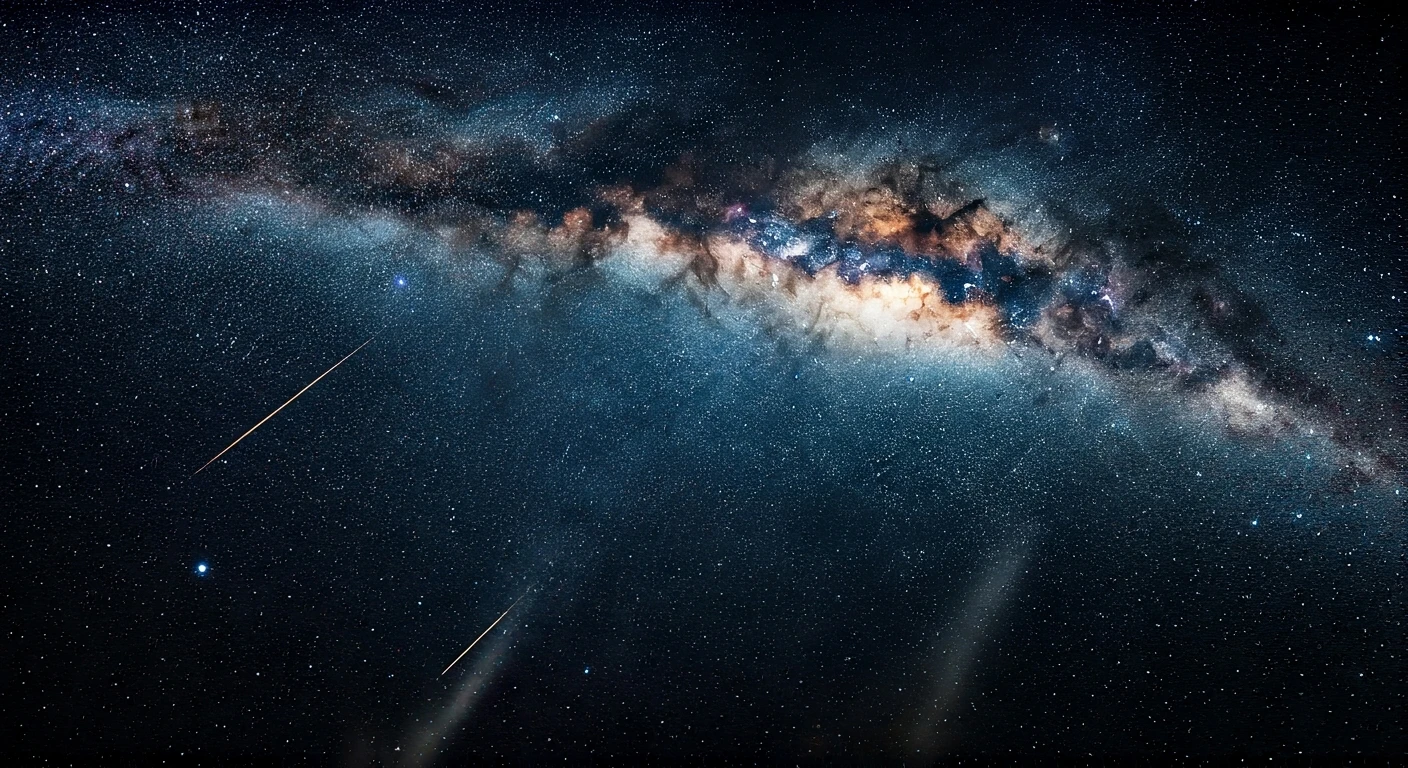
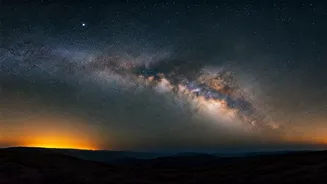
Because space is so large, astronomers use a unit of distance called a 'light-year.' This isn't a measure of time, but the distance light travels in one year—a staggering 9.5 trillion kilometres. When you read that a star is 100 light-years away, it means two things: it is incredibly far, and the light you are seeing from it tonight began its journey 100 years ago. Every star in the night sky, apart from our Sun, is light-years away. This means that when you gaze upwards, you are not seeing a static snapshot of the cosmos. You are looking at a mosaic of different points in time. Each star is a historical record, its light carrying information about what it was doing in the past. The farther away the star, the further back in time you are looking.
Stars From Another Era
Let's make this tangible. Take Polaris, the North Star. It’s a celestial landmark, a fixed point for navigators for generations. Polaris is approximately 433 light-years away. This means the light we see from it today left its surface around the year 1591. While the Mughal emperor Akbar was consolidating his rule over the Indian subcontinent, the light that would one day grace our 21st-century skies was just beginning its long, lonely voyage across the cosmos. Consider another bright star, Betelgeuse, in the constellation of Orion. It’s about 640 light-years distant. The light we see from it tonight started its journey around the 1380s. That’s a window into a world that existed before the Lodhi dynasty even began in Delhi. Every star tells a similar story, connecting our present moment to a distant past.
Ghosts in the Sky
This leads to one of the most profound and unsettling implications of light travel time: we can’t be sure that the stars we see are still there. Betelgeuse, for example, is a red supergiant nearing the end of its life. Astronomers believe it could go supernova—explode in a cataclysmic burst of energy—any time in the next 100,000 years. The twist is, it might have already happened. If Betelgeuse exploded 500 years ago, we wouldn’t know. We would have to wait another 140 years for the light from that explosion to reach us. For all we know, the night sky is filled with the faint, lingering light of stars that are long dead—celestial ghosts whose final messages have yet to arrive.
Galaxies from Before Humanity
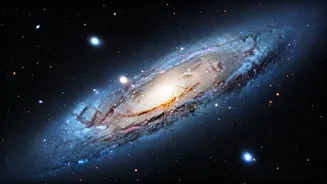
The effect becomes even more dramatic when we look beyond our own galaxy. The Andromeda Galaxy is the closest major galaxy to our Milky Way and is visible to the naked eye as a faint, fuzzy patch on a dark night. It is 2.5 million light-years away. The light hitting your retina from Andromeda tonight left before modern humans, Homo sapiens, even existed on Earth. You are looking at light that began its journey when our distant ancestors, like Homo habilis, were roaming the plains of Africa. It is the oldest thing you can see without a telescope, a faint glimmer from a completely different geological and evolutionary epoch.