
More Than Just a Pretty Accessory
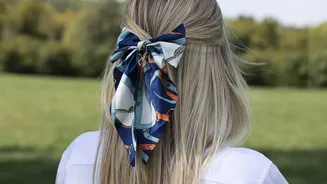
There's a softness sweeping through the world of style, and the hair ribbon is its unofficial emblem. You’ve seen it tied around ponytails, woven into braids, and, most iconically, finishing a simple half-up hairstyle. This isn't just a fleeting trend;
it’s a key piece of the 'coquette' and 'balletcore' aesthetics that celebrate femininity, romance, and a touch of playful charm. Celebrities like Hailey Bieber and Sydney Sweeney have made the simple ribbon a red-carpet staple, but its real power lies in its accessibility. For a few rupees, a piece of satin, velvet, or silk ribbon can transform an entire look, making it one of the most democratic trends in recent memory. It's a small accessory with a big impact, capable of feeling both nostalgic and refreshingly modern at the same time.
A Brief History of the Bow
The act of tying ribbons in hair is far from new. Its history stretches back thousands of years to ancient civilizations like the Sumerians, who fashioned hair ribbons from gold. Throughout history, the bow has carried diverse meanings. In 17th-century France, men wore 'lovelocks'—long braids tied with a ribbon and draped over the heart to signify romantic devotion. Later, French noblewomen, including Marie Antoinette, popularized extravagant hairstyles adorned with cascades of ribbons. In the Victorian era, large bows became a symbol of girlhood innocence, a connotation that still lingers today. The placement of a bow could even communicate a secret language; for teenage girls in the 1940s, it was a code to signal their relationship status. This rich history adds layers of meaning to the simple act of tying a bow in your hair in 2026.
How to Master the Half-Up Bow
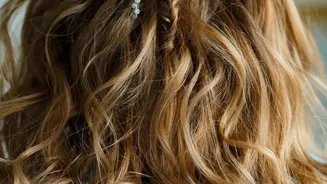
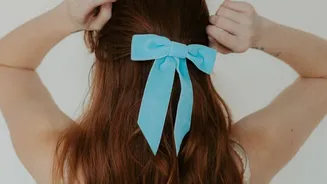
The half-up, half-down style is the quintessential way to wear a ribbon. It’s elegant, keeps hair out of your face, and works on almost any hair length and texture. Best of all, it's incredibly simple to achieve. First, decide on your base texture. The style looks beautiful with soft waves, but also works with straight hair for a more minimalist, sleek look. If your hair is freshly washed and slippery, a light mist of dry shampoo at the roots will provide grip. Next, section the top half of your hair. Use your thumbs to draw a line from your temples back towards the crown of your head and gather this top portion. How high you place the ponytail can change the feel of the look: a higher placement feels more playful and youthful, while a lower one feels softer and more romantic. Secure this section with a thin, clear elastic. The elastic does the work of holding the style in place; the ribbon is purely decorative. Once secured, you can tie your ribbon around the elastic, finishing with a neat bow. For a fuller look, gently tug on the hair at the crown to create a little volume before adding the bow.
Choosing Your Ribbon
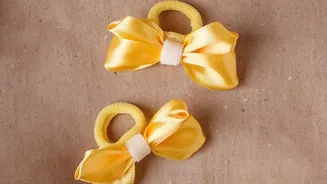
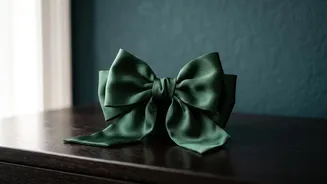
The type of ribbon you choose can dramatically alter the vibe of your hairstyle. A thin, satin ribbon in a pastel shade leans into the soft, 'coquette' aesthetic. A wider, velvet ribbon in a dark colour like black or burgundy feels more dramatic and polished, perfect for an evening look. Even the material makes a difference; silk offers a delicate drape, while a grosgrain ribbon provides more structure. Don't be afraid to experiment with different widths and textures to find what best suits your personal style. For a polished finish, make sure to trim the ends of your ribbon cleanly.
Beyond the Classic Half-Up
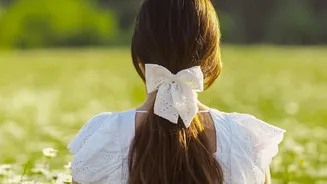
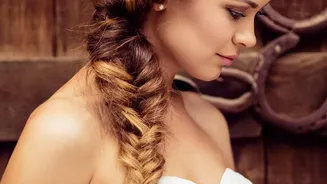
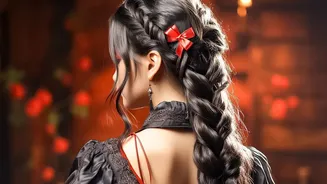
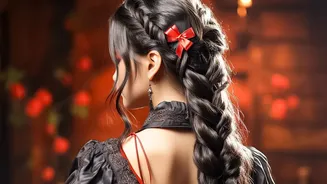
While the half-up style is a classic for a reason, the beauty of the ribbon lies in its versatility. Try tying a long ribbon around the base of a low ponytail, letting the tails hang down your back for an effortlessly chic look. You can also weave a thin ribbon through a braid, treating it as a third strand for a pop of colour and texture. For a more subtle take, small bows can be tied to the ends of pigtails or braids. Some even use multiple tiny bows to adorn a single ponytail, creating a playful, decorative effect. These variations prove that the ribbon is not just an accessory, but a tool for creative expression.