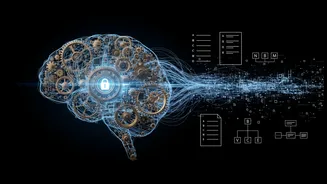






The Privacy Problem with Cloud AI
When you use a popular cloud-based AI assistant, you're not just having a private conversation. These services often use the data you provide—your questions, your code, your half-finished essays—to train their future models. This has led to serious privacy
concerns. There have been documented cases where proprietary company data, pasted into a public chatbot by employees, was absorbed into the model's training set. For students, the risks are just as significant. Uploading a unique thesis or a personal essay could mean that data is stored indefinitely on a third-party server, potentially accessible in a breach or even resurfacing in someone else's query. Many universities, aware of these risks and bound by student data privacy laws, have instituted strict policies forbidding the use of unapproved public AI tools for coursework. Using them could inadvertently violate academic integrity policies.
Going Local: AI That Lives on Your Laptop
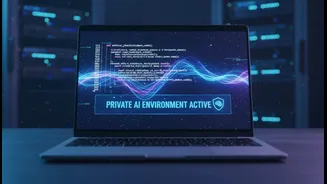
In response, a growing number of tech-savvy students are embracing an alternative: local AI. The concept is simple but powerful. Instead of sending data to a massive server owned by a tech giant, you download and run the AI model directly on your own computer. Think of it as the difference between having a conversation in a crowded public square versus a private room with the door closed. With local AI, your research, personal notes, and draft reviews never leave your hard drive. This provides complete data privacy and security, which is a game-changer for anyone handling sensitive academic work, unpublished findings, or personal information. It also means you can work offline, entirely independent of an internet connection.
Your Private AI Toolkit
Getting started with local AI has become surprisingly accessible. The key is software that manages the AI models for you. A tool called Ollama has emerged as a popular choice, praised for its simplicity. It works like an app store for open-source AI models, allowing you to download different ones with a single command. Users can run powerful models from a wide range of developers, including Meta's Llama series, Google's Gemma, and Mistral's models. Once installed, you can interact with the AI through a command line or connect it to a more user-friendly interface, creating a private ChatGPT-like experience. This flexibility allows a student to choose a model best suited for their task, whether it's summarizing research, improving writing, or brainstorming ideas, all with the assurance of absolute privacy.
The Trade-Offs: Power vs. Privacy
While local AI offers unparalleled privacy and control, it's not without its drawbacks. The biggest trade-off is performance. Running these complex models requires a computer with significant processing power and memory (RAM); older or entry-level laptops may struggle. Furthermore, the most capable, 'frontier' AI models from companies like OpenAI and Google are typically not available for local download. This means there can be a gap in quality and speed; a local model might not be as adept at complex reasoning or creative tasks as its cloud-based counterparts. The cost is another factor. While the software itself is usually free, avoiding subscription fees, the potential need for a hardware upgrade is a consideration.
Academia's AI Balancing Act
Universities find themselves in a tricky position, trying to balance innovation with academic integrity and data security. The response has been varied, with many institutions creating policies that limit AI use or require explicit permission and disclosure from instructors. Some universities are even exploring their own institution-hosted AI systems to provide safe, private access for students and faculty. The rise of local AI offers a compelling middle ground. It allows students to leverage AI as a powerful study aid without compromising their data privacy or running afoul of university rules against sharing sensitive academic material with third parties. It empowers them to use the technology responsibly, focusing on its utility for feedback and brainstorming rather than for generating entire assignments.