
The Sun’s Enduring Riddle
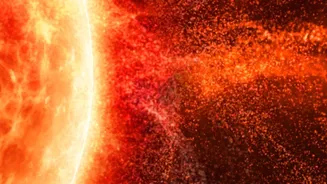
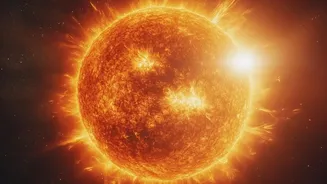
For nearly a century, astronomers have been stumped by the coronal heating problem. Logic dictates that as you move away from a heat source, the temperature should drop. Yet, on the sun, the opposite happens. The surface, or photosphere, is scorching,
but the corona—an ethereal halo of plasma visible during a total eclipse—is hundreds of times hotter. This defies the basic laws of thermodynamics, suggesting that some other, non-thermal process must be pumping incredible amounts of energy into the atmosphere. Scientists have long theorized that the sun's powerful and complex magnetic fields are responsible, but the exact mechanism has remained elusive. Finding this missing link is a holy grail of solar physics.
A Wave in the Plasma
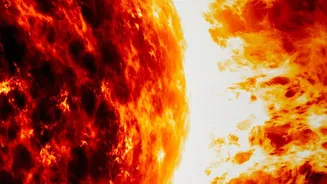
Now, stunning new observations have provided a powerful new piece of evidence. Using the world's largest solar telescope, astronomers have directly observed tiny but powerful vortices and waves in the sun's plasma. Some of these discoveries relate to a specific type of plasma wave, known as an Alfvén wave, which was predicted over 80 years ago by physicist Hannes Alfvén. These waves are not like waves in the ocean; instead, they are twisting disturbances that travel along the sun's magnetic field lines, almost like plucking a guitar string. While larger versions of these waves had been seen before, associated with massive solar flares, recent studies have shown evidence of smaller, constantly occurring waves that could be continuously injecting energy into the corona.
The Eyes on the Sky
This breakthrough was not the result of a single instrument, but a convergence of powerful new technology. Data from the Daniel K. Inouye Solar Telescope in Hawaii provided unprecedented high-resolution images of the sun's surface, revealing features as small as 20 kilometers across. These ground-based observations are complemented by missions flying directly through the sun's atmosphere, like NASA's Parker Solar Probe and the European Space Agency's Solar Orbiter. These probes take direct, or 'in-situ', measurements of the plasma, particles, and magnetic fields, tasting the very environment they are studying. By combining the large-scale views from Earth with the close-up data from space, scientists can finally connect the dots from the surface to the corona.
Connecting the Dots
The new findings suggest a compelling model for how the energy transfer works. Turbulent, boiling motions in the sun's convection zone drag and twist the magnetic field lines that are anchored to the surface. This action launches these magnetic waves, which travel upward into the incredibly thin atmosphere of the corona. As the waves propagate through the plasma, their energy can be converted into heat. One theory is that turbulence causes the energy to cascade down to ever-smaller scales, where it can be absorbed directly by plasma particles. Another possibility involves numerous tiny explosions, dubbed 'nanoflares', which release bursts of energy all over the sun's surface. The newly seen waves provide a mechanism for either or both of these processes to occur.
More Than a Solar Puzzle
Solving the coronal heating problem is about more than just satisfying scientific curiosity. The same mechanisms that heat the corona also power the solar wind, a constant stream of charged particles that flows out and fills the solar system. Sudden, violent releases of energy in the corona can cause solar flares and coronal mass ejections—massive eruptions that hurl plasma into space. When aimed at Earth, this 'space weather' can disrupt satellites, damage power grids, and endanger astronauts. Understanding the fundamental physics of how the sun transports and releases energy is crucial for improving our ability to forecast space weather and protect our technological infrastructure. This newfound wave is a vital step toward that goal.