



The Kayaking Stroke: Power in the Pull
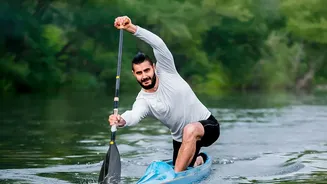
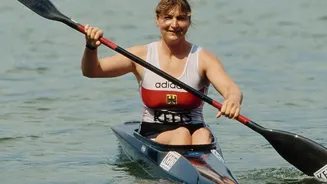
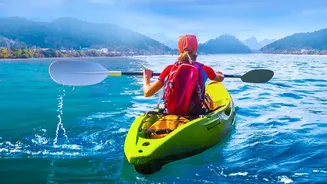
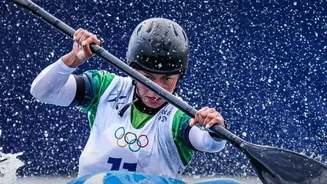
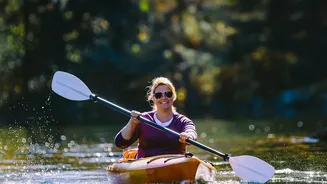
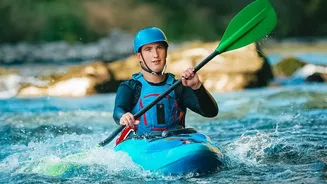
When you see a kayaker gliding across the water, it’s easy to assume their arms are doing all the work. While the arms are heavily involved, the real power in a proper kayaking stroke comes from the core and back. The motion is fundamentally a pull. As
you plant your paddle in the water, you rotate your torso and pull the blade back alongside the boat. This action heavily engages the large muscles of your back, specifically the latissimus dorsi (lats). Your arms act as the critical link, transferring that rotational power into the water. The biceps are engaged during the pulling phase of the stroke, while the triceps work to push with the opposite arm. The shoulders, particularly the deltoids and rotator cuff muscles, are constantly at work, both in providing power and stabilizing the joint through the entire motion.
The Paddleboarding Stroke: Strength in Stability
Stand-up paddleboarding presents a completely different physical challenge. Because you're standing on an unstable surface, your entire body is engaged just to maintain balance. While kayaking is a seated 'pull' workout, paddleboarding is more of a standing 'push' and 'stabilization' exercise. The stroke starts by reaching forward and planting the paddle, then pushing down and back with the paddle shaft acting as a lever. While your arms and shoulders guide the paddle, much of the force is driven by your core and back muscles. However, the specific work for the arms and shoulders is quite distinct. They are used to create a strong frame, with the top arm pushing down on the handle and the bottom arm guiding the blade. This engages the triceps, deltoids, and the stabilizing muscles of the rotator cuff. Unlike the significant bicep work in kayaking's pull motion, the arm work in SUP is more focused on isometric contraction and control.
Shoulder Work: Rotation vs. Stabilization
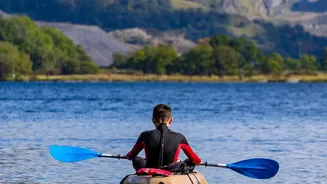
The primary difference in the shoulder workout between the two activities comes down to rotation versus stabilization. Kayaking demands a wide range of motion from the shoulder joint. The deltoids and rotator cuffs work dynamically to lift, pull, and rotate the paddle through the water on every stroke. This builds strength through movement. In contrast, paddleboarding requires immense shoulder stability. The rotator cuff muscles work overtime to keep the shoulder joint secure as you transfer power from your core down through the paddle. While there is still movement, a significant part of the effort is isometric, meaning the muscles are engaged to hold a position rather than move through a range of motion. This is crucial for preventing injury and building functional strength.
Arm Engagement: Biceps vs. Triceps
If you're looking to target specific arm muscles, the choice between kayaking and paddleboarding becomes clearer. Kayaking is a fantastic workout for the biceps and back. The repetitive pulling motion is similar to doing rows at the gym, directly engaging the biceps on the pulling side of each stroke. While the triceps are also involved in the 'push' of the opposite hand, the primary focus is on the pull. Paddleboarding, on the other hand, places more emphasis on the triceps and deltoids. The downward push on the paddle handle with your top hand heavily involves the triceps. The overall motion relies less on a bicep-heavy pull and more on a controlled push and lever action, creating a different kind of toned strength in the arms.
Which is Right for Your Fitness Goals?
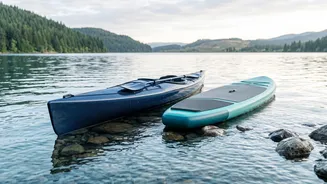
Ultimately, neither sport is 'better'—they are just different. The best choice depends entirely on your personal fitness objectives. If your goal is to build a powerful back and strong biceps with a workout that emphasizes rotational core strength and upper-body endurance, kayaking is an excellent choice. You'll get a concentrated upper-body workout in a stable, seated position. If you're seeking a full-body workout that heavily challenges your balance, core stability, and builds shoulder and tricep strength through stabilization and pushing motions, then stand-up paddleboarding is for you. It engages more muscle groups simultaneously, from your feet to your shoulders, offering a more holistic, but less targeted, upper-body session.