

A Constant Vigil on Our Star
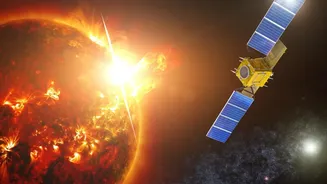
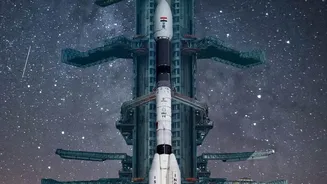
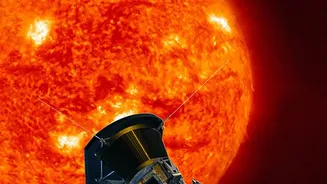
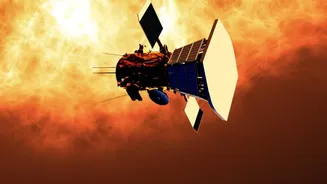
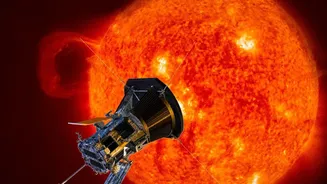
Positioned at the unique Lagrange Point 1 (L1), about 1.5 million kilometres from Earth, Aditya-L1 enjoys an uninterrupted view of the Sun. This mission, launched by the Indian Space Research Organisation (ISRO), isn't just about observation; it's about protection.
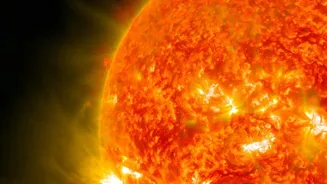
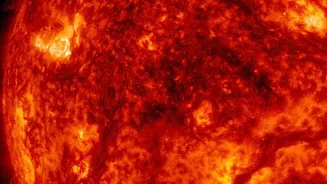
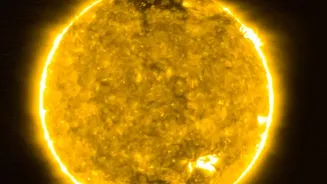
Its primary goal is to study the Sun's atmosphere, solar winds, and powerful eruptions known as Coronal Mass Ejections (CMEs). Unlike missions that orbit Earth, Aditya-L1's location allows it to see solar events unfold long before their effects reach our planet. This strategic placement is key to its role as an early-warning system. The spacecraft is equipped with seven sophisticated payloads designed to monitor the Sun's various layers, ensuring that solar activity is tracked comprehensively.
Why We Need to Predict Solar Weather
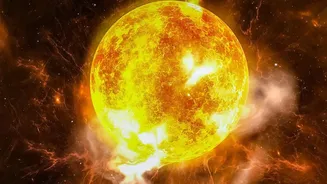
To most of us, the Sun is a steady source of light and warmth. But it is also a volatile star capable of unleashing immense energy. Solar storms, particularly CMEs, eject billions of tonnes of charged particles into space. If a powerful storm heads towards Earth, it can have serious consequences for our technology-dependent civilisation. These geomagnetic storms can cripple power grids, disrupt high-frequency radio communications, knock out GPS services, and damage the satellites we rely on for everything from banking to broadcasting. Predicting their arrival and intensity is therefore not just an academic exercise; it's a critical component of national and global security. Better forecasting gives operators time to safeguard satellites and protect vital infrastructure.
The Breakthrough Data from Aditya-L1
Recent findings from Aditya-L1 mark a significant leap forward in this predictive capability. The Visible Emission Line Coronagraph (VELC) has provided fascinating details about CMEs, observing changes in the corona's brightness and temperature during an eruption. Instruments like the Solar Wind Ion Spectrometer (SWIS) and Plasma Analyser Package for Aditya (PAPA) are measuring the solar wind directly, providing insight into the material ejected from the Sun. At the same time, spectrometers like HEL1OS are capturing the earliest signs of solar flares by detecting intense X-ray flashes. By combining these different data streams, scientists get a much fuller, multi-layered picture of an impending solar event.
From Data to Actionable Warnings
This new stream of information is a force multiplier for existing space weather models. By observing both the energetic particles and the initial flare flashes, scientists can better predict a storm's arrival time and intensity. For instance, ISRO announced that direct measurements from the ASPEX instrument were crucial in confirming that an unusual magnetic disturbance on Earth was driven by a sudden change in solar wind pressure. This enhanced accuracy transforms forecasting from a rough estimate into an actionable alert, giving grid operators and satellite companies precious hours to take preventative measures. Understanding how CMEs evolve and are deflected as they travel is key to improving how we predict their impact.
India's Rising Stature in Space
The success of Aditya-L1 cements India's position as a major player in space science and exploration. Following the historic Chandrayaan-3 lunar landing, this mission demonstrates ISRO's growing capability to undertake complex science missions that provide value to the entire world. By placing a state-of-the-art observatory at L1, India has joined an elite club of nations contributing to the vital task of monitoring space weather. This isn't just a matter of national pride; it's a demonstration of India's commitment to using its technological prowess for global good. The data from Aditya-L1 is a shared resource, protecting infrastructure and lives far beyond India’s borders and heralding a new era of collaborative space safety.