


The Cosmic Data Bottleneck
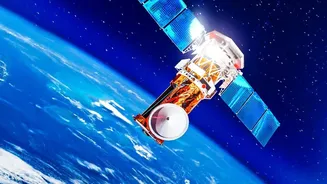
Since the dawn of the space age, humanity has relied on radio waves to talk to its robotic explorers. This technology, managed by networks like NASA's Deep Space Network (DSN), has been instrumental in countless missions. But as our scientific instruments
become more powerful, capturing high-definition images and vast datasets, radio communication has become a frustrating bottleneck. Transmitting large files from Mars or beyond can take an agonizingly long time, limiting the pace of discovery. Imagine trying to stream a 4K movie over an old dial-up connection—that’s the scale of the problem scientists face. This limitation directly impacts mission design, forcing planners to be selective about the data they collect and send home.
A Breakthrough Written in Light
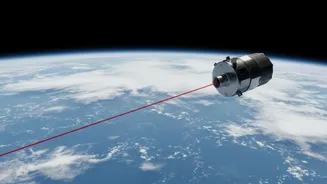
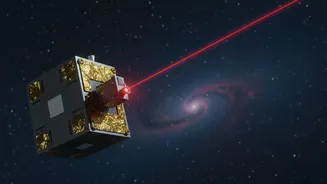
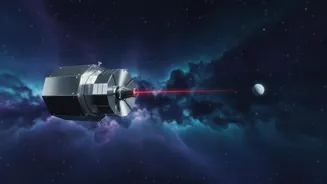
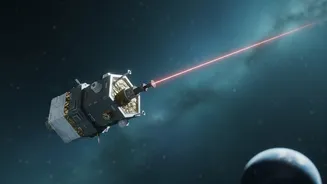
The solution is not a better radio, but a fundamental shift in technology: using lasers. Specifically, near-infrared light. Instead of broadcasting a wide, diffuse radio signal, this new method, called free-space optical communications (FSOC), sends a highly focused beam of light encoded with data. Think of it as the difference between a floodlight and a laser pointer. While both provide light, the laser is far more concentrated and efficient for sending a precise signal over enormous distances. This technology packs data into much tighter waves, allowing ground stations to receive significantly more information in a single transmission.
Putting Theory into Practice: The DSOC Experiment
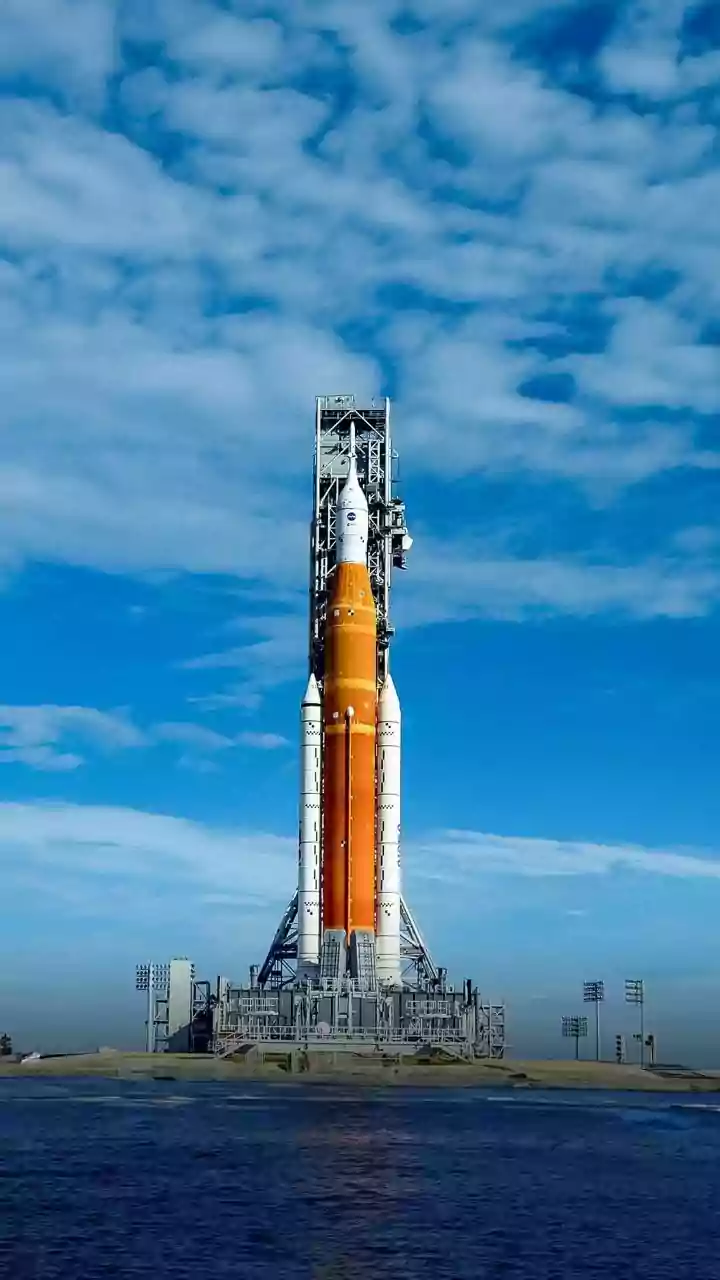
NASA has been rigorously testing this game-changing technology with its Deep Space Optical Communications (DSOC) experiment. Flying aboard the Psyche spacecraft, launched in October 2023, the DSOC system has shattered expectations and records. In one of its most famous tests, it streamed an ultra-high-definition video of a cat named Taters from 19 million miles away. More importantly, it achieved a maximum data rate of 267 megabits per second (Mbps)—a speed comparable to terrestrial broadband internet. Even at its farthest test distances, comparable to the maximum gap between Earth and Mars, the system transmitted data at rates many times faster than the best radio systems could manage. These tests have successfully proven that optical communication is a viable and robust technology for future deep space missions.
Why '100 Times Faster' Is a Realistic Goal
The headline's claim of a hundredfold speed increase isn't just hype; it's the target that this technology is designed to achieve. The dramatic increase in bandwidth comes from the physics of light itself. Infrared light has a much higher frequency than radio waves, which means more data can be packed into each transmission. While radio signals spread out and weaken over distance, a laser beam remains tightly focused, delivering more energy and information to its target receiver. The DSOC project demonstrated that this technology can deliver data at rates 10 to 100 times greater than current state-of-the-art radio systems used on deep space missions today. This leap in performance reduces the size, weight, and power requirements for a spacecraft's communication system, which are critical advantages for any mission.
The Future of the Interplanetary Internet
The success of infrared laser communication marks the beginning of a new chapter in space exploration. It paves the way for an interplanetary internet, where high-bandwidth links connect Earth with missions on the Moon, Mars, and beyond. This will enable scientists to receive vast quantities of data almost in real-time, accelerating discoveries. For future human missions, the implications are even more profound. Astronauts on Mars could stream high-definition video back to Earth, conduct complex remote operations, and stay connected with mission control in ways that are simply impossible with today's technology. While challenges like atmospheric interference and the need for a global network of optical ground stations remain, the path forward is clear. The era of the cosmic dial-up is ending, and a high-speed, light-based connection to the stars is just beginning.