





Safety Above All Else
Sending humans to space is an incredibly complex and risky endeavour. That’s why, before any astronaut boards the Gaganyaan spacecraft, the Indian Space Research Organisation (ISRO) is conducting a rigorous series of uncrewed test flights. The primary
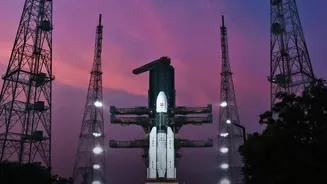
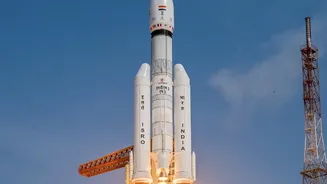
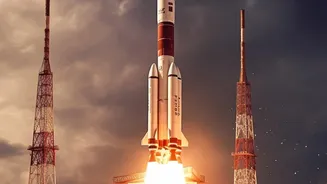
goal of these missions is to perfect one thing above all: the Crew Escape System (CES). This system is the ultimate safety net, designed to pull the crew module and its occupants away from the launch vehicle in a fraction of a second if anything goes wrong. These tests, like the successful Test Vehicle Abort Mission-1 (TV-D1), are designed to simulate worst-case scenarios to ensure the CES works flawlessly when it matters most. The entire process is a demonstration of ISRO's commitment to human safety, proving every component of the abort sequence long before a human life is on the line.
The Rocket's Nervous System
At the heart of the monitoring process is the Integrated Vehicle Health Management System (IVHM). Think of it as the rocket's digital brain and nervous system, a sophisticated network of sensors and computers working in unison. This system’s job is to continuously check the health of the entire launch vehicle. It monitors thousands of parameters in real-time, from engine performance to structural integrity. The IVHM doesn't just collect data; it analyses it, looking for any deviation from expected norms that could signal an impending failure. For Gaganyaan, this system has been made even more robust and redundant, as its most critical function is to decide, autonomously, if an abort is necessary. This reduces the burden on ground controllers and ensures that an escape can be triggered instantly.
The Critical Numbers Game
During ascent, ISRO's control room is laser-focused on a few key parameters that determine whether a flight is proceeding normally or heading for disaster. One of the most critical moments is 'Max-Q', or maximum dynamic pressure. This is the point in the flight where the combination of the rocket's speed and the air density creates the maximum structural stress on the vehicle. The TV-D1 test, for example, specifically simulated an abort at Mach 1.2—the transonic phase where these aerodynamic forces are immense. Other crucial parameters include the rocket's altitude, velocity, and its flight path angle. Any significant deviation from the planned trajectory could indicate a loss of control, prompting the IVHM to initiate an abort sequence. The system is so sensitive that during a TV-D1 launch attempt, an engine anomaly was detected just five seconds before liftoff, automatically putting the launch on hold — a perfect demonstration of the safety protocols working as designed.
Anatomy of an Abort
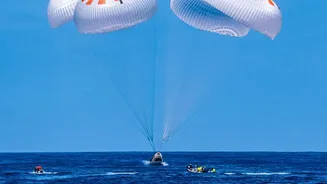
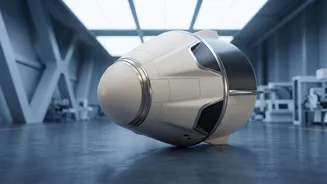
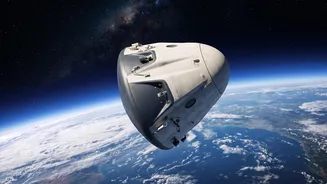
So what happens when a critical parameter goes out of bounds? The abort sequence is executed autonomously. First, powerful, fast-acting solid motors in the Crew Escape System fire, instantly separating the crew module from the main rocket and pulling it to a safe distance. This happens in the blink of an eye. Once clear, the escape system detaches, and the crew module begins its descent. A carefully orchestrated sequence of parachutes then deploys—first smaller drogue chutes to stabilize and slow the capsule, followed by the main parachutes to ensure a gentle splashdown in the sea. The entire operation, from abort trigger to splashdown, is a precise, pre-programmed dance designed to protect the crew at any altitude, whether on the launch pad or high in the atmosphere.
The Human Element in the Loop
While the abort system is designed to be autonomous, the control room at the Satish Dhawan Space Centre is teeming with some of India’s brightest minds. These engineers and scientists are not passive observers. They are the human oversight, monitoring the torrent of data from the vehicle and cross-verifying the performance of every system. They watch the health of the launch vehicle, the trajectory, and the communication links. During the test flights, their role is to evaluate how well the automated systems perform and gather crucial data that will be used to refine the systems for future missions. After splashdown, their work continues, coordinating with recovery teams, like the Indian Navy, to retrieve the crew module and analyse the invaluable flight data captured onboard.