
A New Geometric Wonder
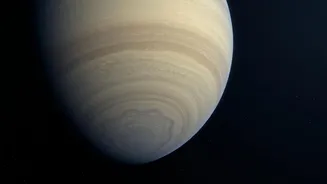
In a discovery that has captivated astronomers, recent observations have confirmed the existence of a massive decagonal, or 10-sided, structure encircling Saturn's south pole. This isn't just a faint pattern on the surface; it's a powerful atmospheric
wave embedded deep within one of the planet's high-speed jet streams. Unlike a storm that churns and dissipates, this feature has a distinct, repeating geometric shape. The discovery was officially announced in September 2026, based on data collected by the Hubble Space Telescope. It marks the first time such a large, regular-sided pattern has ever been seen in Saturn's southern hemisphere, presenting a fresh puzzle for planetary scientists.
Not Saturn's First Polygon
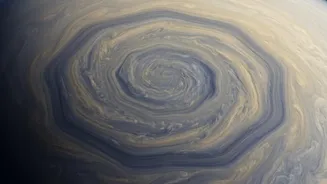
This isn't the first time scientists have found strange geometry in Saturn's atmosphere. For over 40 years, since it was first spotted by the Voyager probes in the 1980s, the planet's north pole has been home to a famously stable six-sided jet stream known as 'the hexagon'. For decades, astronomers wondered why this feature was unique to the north. The Cassini spacecraft, which orbited Saturn from 2004 to 2017, found no matching polygon in the south. The sudden emergence of this new southern decagon suggests that such phenomena might be a more common, if fleeting, feature of Saturn's atmospheric dynamics than previously believed, and that the northern hexagon might not be such an anomaly after all.
How The Discovery Was Made
The discovery was a collaborative effort, kicked off by amateur astronomers. In 2024, observers using ground-based telescopes noticed a subtle, wavy pattern near the south pole. This prompted professional astronomers to take a closer look using the unparalleled vision of the Hubble Space Telescope. By analysing Hubble images, scientists were able to confirm the 10-sided shape and even trace its origins back to fainter patterns visible in data from 2023. This new feature was only discoverable recently because Saturn's seasonal tilt had hidden its south pole from Earth's view for over a decade, between 2012 and 2023.
The Science Behind the Shape
So, what causes a planet's atmosphere to form a 10-sided shape? The leading theory points to a type of phenomenon known as an atmospheric wave, or Rossby wave. These waves naturally occur in rotating fluids, like the atmospheres of planets. On a fast-spinning gas giant like Saturn, powerful jet streams can be bent into stable, geometric shapes by these waves. While the northern hexagon has been remarkably stable, this southern decagon appears to be younger and still evolving, giving scientists a rare opportunity to watch one of these massive patterns form in real-time. The exact trigger remains a mystery, but some theories suggest that a nearby cyclonic vortex may have provided the initial disturbance that kicked off the wave's formation.
Why This Cosmic Geometry Matters
This discovery is more than just a cosmic curiosity. It provides a unique natural laboratory for understanding the physics of planetary atmospheres. By studying how the decagon formed and how it changes over time, scientists can refine their models of how weather works on gas giants. Observing the structure's evolution can offer clues about the deep, unseen processes driving Saturn's climate and its powerful winds. Because this feature appears to be brand new and is still strengthening, it offers a real-time window into planetary dynamics that a static feature like the northern hexagon cannot. The continued monitoring of this decagon by Hubble and the James Webb Space Telescope will be crucial to solving this intriguing atmospheric mystery.