


A Sweet Discovery in the Void
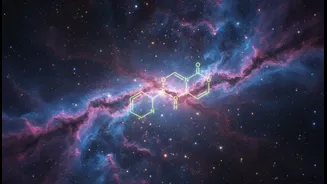
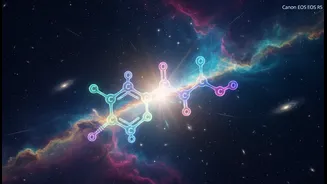
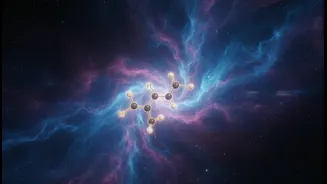
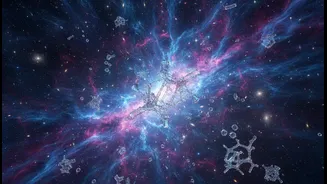
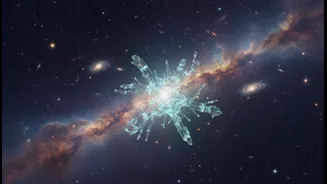
In a paper published just this week, an international team of researchers announced the first-ever detection of a true sugar in the interstellar medium. Using powerful radio telescopes in Spain, they identified the chemical fingerprint of erythrulose,
a four-carbon sugar, in a vast cloud of gas and dust named G+0.693-0.027, located about 26,745 light-years from Earth. While simpler organic molecules have been found in space before, this is the largest non-cyclic molecule and the very first sugar spotted in the void between stars. Interestingly, on Earth, erythrulose is found in raspberries and is also used in sunless tanning products. Its presence in space, however, has far more profound implications.
Why This Sugar Matters
The discovery is a massive step forward in understanding the origins of life. Sugars are essential biomolecules; they are a source of energy for cells and, crucially, form the structural backbone of RNA and DNA. One of the biggest puzzles in prebiotic chemistry is how these vital sugars formed on the early Earth, as lab experiments have struggled to produce them in sufficient quantities. The detection of erythrulose in space lends significant weight to the theory that the building blocks of life didn't necessarily have to form on our planet. Instead, they may have been created in space and delivered to Earth billions of years ago by comets and meteorites. Scientists estimate millions of tonnes of erythrulose could have rained down on the young Earth during the period known as the Late Heavy Bombardment.
A Surprising Chemical Recipe
What makes the finding even more exciting is how the erythrulose appears to have formed. The prevailing view was that complex molecules in space are built sequentially, adding one carbon atom at a time. However, the team found that erythrulose was at least eight times more abundant than any simpler, three-carbon sugars in the same cloud. This challenges existing theories. The new hypothesis is that erythrulose forms on the icy surfaces of cosmic dust grains from the combination of two smaller, two-carbon molecules that are common in space. This suggests that the pathways to creating complex, life-sustaining molecules might be more varied and robust than previously thought, even in the frigid -250C temperatures of deep space.
What Remains Unclear
While this is a breakthrough, many questions remain. A crucial one revolves around chirality, or the "handedness" of molecules. Life on Earth exclusively uses right-handed sugars. It is not yet known if the interstellar erythrulose shows a preference for one handedness over the other. Discovering a chiral imbalance in space would be a monumental clue in understanding why life has this specific preference. Furthermore, while we've found the ingredients, we haven't found the finished recipe. Scientists still need to understand how these molecules could survive the violent journey to a planet's surface and how they would then assemble into the first living organisms. This discovery is a piece of the puzzle, not the final picture.
The Hunt Continues
The detection of erythrulose has energized the field of astrobiology. Researchers are already planning follow-up observations to confirm its abundance and search for it in other star-forming regions. The ultimate prize would be to detect even more complex sugars, like ribose, the five-carbon sugar that is a central component of RNA. According to Dr. Izaskun Jiménez-Serra, who led the research, this finding opens the possibility that the key ingredients for life are present across the galaxy. This single detection has turned the vast emptiness of space into a realm of chemical possibility, bringing us one step closer to answering the fundamental question of whether we are alone in the universe.