




A Problem of Timing
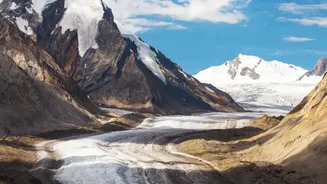
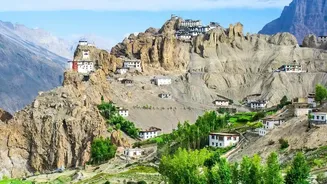
Ladakh, a cold desert in the Indian Himalayas, depends almost entirely on the slow melt of glaciers for its water. With less than 100 mm of rainfall annually, glacial meltwater feeds the streams that enable agriculture and sustain life. However, climate
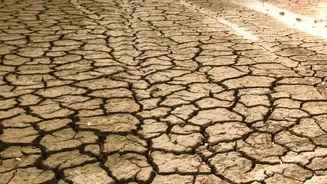
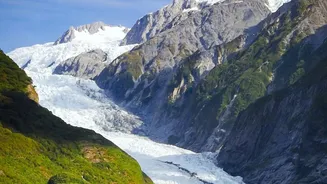
change has disrupted this ancient rhythm. Rising temperatures are causing glaciers to retreat at an alarming rate, a trend observed across the Himalayan region. The issue for Ladakhi farmers is not just the loss of ice, but the timing of the melt. Winter snow and glacial ice now melt faster and earlier, in February and March, when it is too cold to plant crops. By the critical sowing months of April and May, the streams have often run dry, only to flood again when the summer sun beats down on the high-altitude glaciers. This mismatch leaves farmers with no water when they need it most.
The Birth of a Simple, Powerful Idea
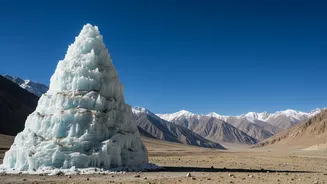
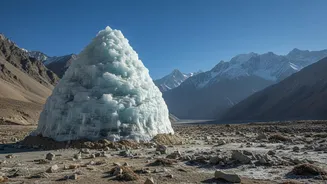
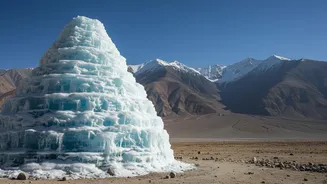
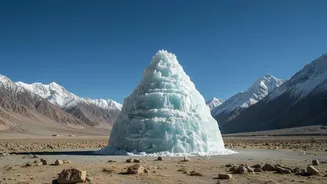
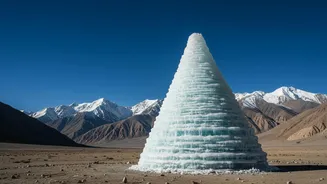
The solution came from Ladakhi engineer and innovator Sonam Wangchuk. He was inspired by a simple observation: ice that remained frozen under a bridge well into the summer, protected from direct sunlight. While shading entire glaciers was impossible, he wondered if the shape of the ice could make it last longer. Drawing on high school geometry, Wangchuk realised that a cone has the minimum surface area for a given volume. An ice cone would expose the least possible area to the sun, slowing the melting process significantly. He named these artificial glaciers 'ice stupas' because their conical shape resembles the traditional Buddhist monuments that are sacred in Ladakh.
How to Build a Mountain of Ice
The engineering behind an ice stupa is remarkably simple and elegant, requiring no pumps or external power. A pipe is laid to carry water from a glacial stream at a higher altitude down to a village. Due to gravity, the water travels down the pipe and, when released through an upright pipe at the lower end, shoots upwards like a fountain. During the frigid Ladakhi winter, with temperatures dropping below -20°C, this fine spray of water freezes as it falls, gradually forming a massive cone of ice. The first prototype, built in 2013-2014, stood over six metres tall and stored 150,000 litres of water that would have otherwise flowed away unused. This ice mountain then melts slowly in the spring, releasing water for irrigation exactly when farmers need it.
From a Single Cone to a Regional Movement
Following the success of the first prototype, the ice stupa concept has expanded rapidly. Initially funded through a crowdfunding campaign, the project has gained global recognition and support, including a Rolex Award for Enterprise for Wangchuk. The project is managed by organisations he co-founded, including the Students' Educational and Cultural Movement of Ladakh (SECMOL) and the Himalayan Institute of Alternatives, Ladakh (HIAL). To encourage local adoption, HIAL organises an annual 'Ice Stupa Competition,' which has spurred villages across the region to build their own. As of recent counts, there are over 50 functioning ice stupas in Ladakh, with some storing millions of litres of water. The idea has even spread internationally, with stupas being built in Switzerland.
More Than Just Water
The impact of ice stupas goes beyond irrigation. They are helping to rehabilitate villages that were abandoned due to water scarcity. By providing a reliable water source, they are securing livelihoods in agriculture and enabling communities to plant millions of trees, turning barren land green. The project has also become a symbol of community-led climate adaptation, empowering local people to solve their own problems using a blend of traditional knowledge and modern science. Furthermore, the striking ice towers have become a tourist attraction, creating new opportunities for eco-tourism and even ice-climbing festivals, boosting the local economy. As the technology evolves with automation to improve efficiency, ice stupas stand as a powerful symbol of hope and ingenuity in the face of a changing climate.