






The Power of a Bigger Bucket
In astronomy, a telescope's primary job is to collect light. The 'aperture' is the diameter of its main mirror or lens, and simply put, a larger aperture acts like a bigger bucket for catching photons—the fundamental particles of light. Doubling a telescope's aperture quadruples
its light-gathering power. This is crucial for planetary science because many objects of interest, like distant asteroids, comets, and Kuiper Belt Objects beyond Neptune, are incredibly faint. More light means a brighter, clearer image, turning faint, invisible specks into detectable and observable bodies. Without the immense light-gathering capability of large apertures, these faint but scientifically vital objects would remain completely unseen.
Resolution: Seeing in High Definition
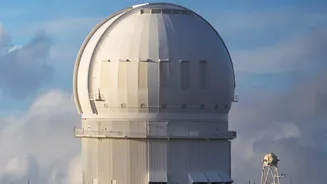
Beyond just making things brighter, a larger aperture provides higher resolution. This is the ability to distinguish fine details. Think of it as the difference between a blurry, pixelated photo and a sharp, high-definition one. For planetary scientists, high resolution is essential for several reasons. It helps in separating two objects that appear very close together, like a faint moon orbiting a planet or a newly discovered asteroid near a bright star. When observing planets within our own solar system, greater detail can reveal atmospheric phenomena, the composition of a moon's icy surface, or volcanic activity. For example, observations at the W. M. Keck Observatory in Hawai'i have revealed details about Jupiter's moon Europa and helped characterise the first rocky, Earth-sized exoplanet. This level of detail is only possible when the telescope's mirror is large enough to resolve it.
The Cosmic Census: Surveys and Planetary Defense
Many large observatories are not just pointed at one object at a time; they conduct massive 'cosmic surveys'. This involves repeatedly scanning huge swathes of the sky to create a dynamic map of the cosmos. For planetary science, this is a game-changer. Observatories like the Vera C. Rubin Observatory in Chile, with its 8.4-meter mirror, can image the entire southern sky every few nights. This rapid, wide-field capability makes it an unparalleled tool for discovering moving objects. In its early operations, Rubin has already identified thousands of previously unknown asteroids. This work is fundamental to planetary defense. By finding and tracking Near-Earth Objects (NEOs), these surveys provide crucial warning time if an asteroid poses a potential impact threat to Earth. It's estimated Rubin will nearly double the catalogue of known large NEOs.
Unlocking the Secrets of Planet Formation
Large telescopes do more than just spot existing planets and asteroids; they allow scientists to witness the birth of new worlds. By peering into protoplanetary disks—the rotating clouds of gas and dust around young stars—observatories can find evidence of planets in the process of forming. For instance, astronomers using the Keck Observatory confirmed the youngest planet ever detected, which is still actively gathering material from its star's disk. These observations provide direct evidence for theories of how giant planets grow. Future facilities like the Extremely Large Telescope (ELT), with its colossal 39-meter primary mirror, will push this even further. The ELT will be able to probe the earliest stages of planetary system formation and even detect water and organic molecules in these stellar nurseries, searching for the building blocks of life.
Studying Worlds Beyond Our Own
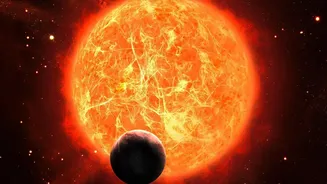
The study of planetary science now extends far beyond our own solar system to 'exoplanets' orbiting other stars. Large ground-based telescopes are at the forefront of this field. Using advanced instruments, they can not only detect these distant worlds but also begin to characterise them. For example, by analysing the faint light from a planet, astronomers can measure its spin rate or look for clues about its atmospheric composition. The next generation of Extremely Large Telescopes (ELTs) are being designed with the primary goal of studying exoplanets in unprecedented detail. The Giant Magellan Telescope, for example, aims to directly image Earth-like planets, a feat that requires immense light-gathering power and incredibly sharp resolution provided by adaptive optics. These observatories will be essential in the search for habitable worlds.