


Sailing on Beams of Light
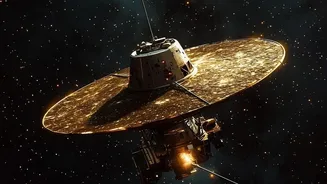
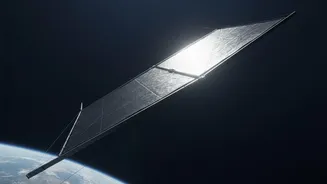
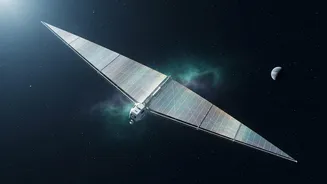
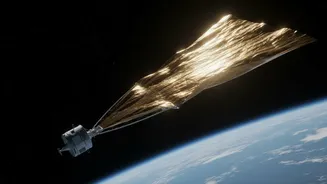
Imagine a vast, shimmering sheet, thinner than a human hair, unfurling in the silent vacuum of space. This isn't science fiction; it's a solar sail. Unlike traditional spacecraft that are essentially controlled explosions, a solar sail has no engine,
no moving parts, and carries no propellant. Its fuel is sunlight itself. The concept is elegantly simple: just as a sailboat's canvas catches the wind, a solar sail's reflective surface catches the constant stream of photons flowing from the sun. It's a technology that promises to redefine the economics and timeline of deep-space exploration. Missions like Japan's IKAROS and The Planetary Society's LightSail 2 have already proven that the principle works, paving the way for a new era of cosmic travel.
The Gentle Push of a Photon
How can light, which has no mass, push a spacecraft? The answer lies in momentum. Light particles, or photons, have momentum, and when they strike a reflective surface and bounce off, they transfer that momentum to the sail, giving it a tiny push. In the frictionless environment of space, this continuous, gentle nudge adds up. While the force from a single photon is minuscule—about the weight of an ant on your hand for an entire football-field-sized sail—the key is that the push is constant. Unlike a chemical rocket that provides a powerful but short-lived burst of acceleration, a solar sail accelerates continuously as long as it is exposed to sunlight. This constant thrust, however small, is the secret to its incredible potential speed.
Escaping the Tyranny of Fuel
The single biggest constraint in space exploration is fuel. At launch, up to 95% of a rocket's weight can be propellant and the tanks to hold it. This leaves very little room for the actual scientific instruments or payload. By eliminating the need for onboard fuel, solar sails fundamentally change this equation. A sail-powered craft can be significantly lighter, which means it could be launched on smaller, less expensive rockets. More importantly, with an effectively infinite fuel source, the operational lifetime of a mission is no longer limited by how much propellant it can carry. This opens the door to long-duration missions, sustained observation posts in unique orbits, and the ability to change course mid-journey without a fuel penalty.
A Marathon, Not a Sprint
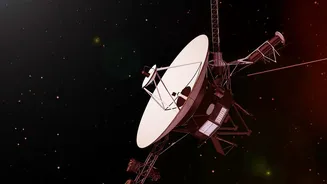
A solar sail won't win a race against a chemical rocket in the first few days. Its initial acceleration is slow and gradual. For a quick trip to Mars, a conventional rocket is still faster. However, for long-haul journeys to the outer solar system and beyond, the solar sail's constant acceleration allows it to eventually overtake its fuel-burning counterparts and achieve much higher terminal velocities. Scientists estimate that advanced solar sails, perhaps using a gravitational slingshot maneuver around the sun, could reach speeds five to ten times faster than our fastest conventional probes, like Voyager 1. This could reduce a multi-decade trip to the edge of our solar system to just a few years, making missions to intercept interstellar objects or explore the outer planets far more feasible.
Challenges on the Cosmic Horizon
Despite its immense promise, solar sail technology faces significant engineering hurdles. The sails themselves must be incredibly large, lightweight, and durable, capable of being packed into a tiny volume for launch and then deploying flawlessly in space. These vast, fragile structures must be controlled precisely to steer the spacecraft, a complex challenge given their size and flexibility. They also need to withstand the harsh space environment, including radiation and potential impacts from micrometeoroids. Current research, including NASA's Advanced Composite Solar Sail System (ACS3), is focused on developing new materials and stronger, lighter booms to support ever-larger sails, pushing the technology from demonstration to a primary tool for scientific discovery.