


A Marathon on Another World
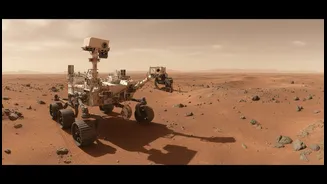
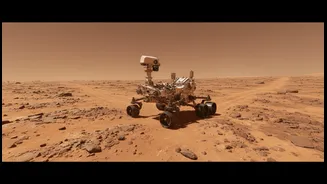
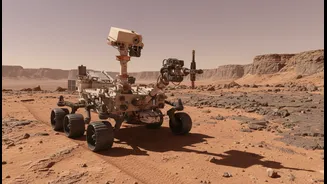
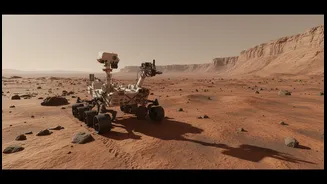
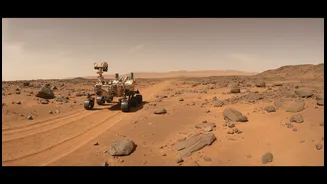
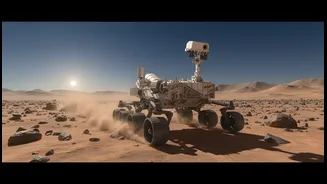
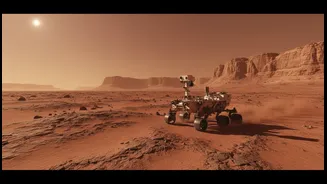
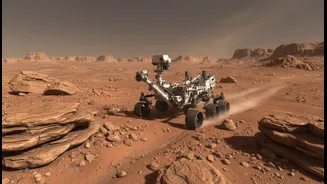
In mid-2026, NASA's Perseverance rover officially crossed the marathon finish line, having travelled 26.2 miles across the rugged surface of Mars. This incredible journey through Jezero Crater was accomplished in just over five years, a blistering pace
for a robotic explorer. To put this into perspective, the legendary Opportunity rover took more than 11 years to cover the same distance. This isn't just about speed; it's about a fundamental shift in our ability to explore other planets. Every kilometre logged by Perseverance is a kilometre of scientific discovery, from drilling rock cores to analysing the chemical building blocks of the Red Planet. The rover's epic trek is painting a clearer picture than ever before of Mars's ancient past, a time when water flowed freely.
For Engineers: A Leap in Autonomy
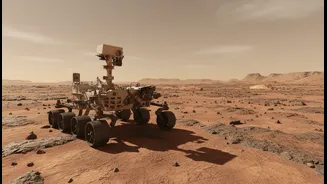
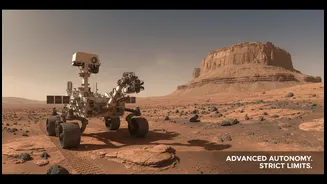
The secret to Perseverance's record-breaking pace is a game-changing technology called AutoNav. For engineers, this is the real headline. Previous rovers, like Curiosity, operated on a stop-and-go basis: drive a little, stop, take pictures, wait for commands from Earth, then drive again. Perseverance, however, can 'think while driving'. It uses a powerful suite of stereo cameras and a dedicated onboard computer to create 3D maps of the terrain in real-time, identifying and navigating around hazards without waiting for human intervention. This AI-powered system has allowed the rover to traverse complex boulder fields that would have taken weeks to navigate previously. For an engineer or computer scientist, this represents a major leap in autonomous systems, combining computer vision, AI pathfinding, and robust hardware to create a true robotic partner for exploration, one capable of making its own decisions millions of kilometres from home.
For Readers: Unlocking Mars's Secrets
This marathon wasn't just a drive; it was a scientific expedition. The extended range and speed have allowed Perseverance to explore more diverse and promising geological sites than any previous mission. Along its path, the rover has made some of the most compelling discoveries in the search for ancient life. Recently, while exploring a region known as the 'Bright Angel' outcrop, its instruments detected the largest and most complex cache of organic molecules ever found on Mars. These carbon-based molecules, while not proof of life themselves, are the essential building blocks. Finding them in what was once a riverbed provides tantalizing new evidence that Mars may have had all the necessary ingredients to be habitable billions of years ago.
For Students: Your Future in Robotics
For robotics students in India and around the world, Perseverance is more than just a mission; it's a moving blueprint for the future. The technologies that allow it to navigate Mars are directly related to the skills that are increasingly in demand in India's own growing space and technology sectors. Fields like artificial intelligence, machine learning for pathfinding, and computer vision are not just theoretical concepts; they are being put to the test every single day on Mars. The rover is a multidisciplinary marvel, requiring mechanical engineers to design its rugged wheels, electrical engineers for its power systems, and computer scientists for its brain. Understanding how Perseverance works is to understand the future of robotics—a future where autonomous systems will explore not just other planets, but also the depths of our oceans and other challenging environments right here on Earth.