
Why This Icy Moon?
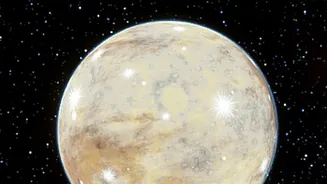
Europa is more than just a ball of ice. The primary evidence for its ocean comes from data gathered by the Galileo spacecraft, which orbited Jupiter from 1995 to 2003. Galileo detected a magnetic field around Europa that is best explained by a global,
electrically conductive layer, like a salty ocean. The moon’s surface is also geologically young and smooth, with vast cracks and streaks but few large craters, suggesting it is constantly being resurfaced from below. The driving force behind this activity is thought to be tidal flexing. As Europa orbits Jupiter, the gas giant's immense gravity squeezes and stretches the moon, generating enough internal heat to keep the ocean liquid beneath its icy shell, which could be 100 kilometers thick.
The First Step: Europa Clipper
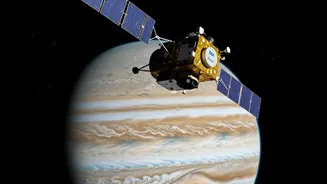
NASA has been clear that its flagship mission, Europa Clipper, is not designed to find life directly. Instead, its main goal is to assess Europa's habitability by determining if the essential ingredients for life—water, chemistry, and energy—are present. Launched in October 2024, Clipper will arrive in the Jupiter system in 2030 and perform dozens of close flybys of the moon. Its suite of nine advanced instruments includes an ice-penetrating radar to measure the thickness of the ice shell, spectrometers to identify surface composition, and a magnetometer to confirm the ocean's existence, depth, and salinity. By mapping Europa in unprecedented detail, Clipper will identify promising locations for a future search for life.
Hunting for Life's Fingerprints
So, how would we even recognize alien life? Scientists search for biosignatures—molecules or patterns that point to biological processes. On Europa, this could mean finding complex organic molecules like lipids or amino acids, which are the building blocks of life on Earth. One of the most exciting possibilities is that Europa, like Saturn's moon Enceladus, erupts with plumes of water vapor from its ocean. If Europa Clipper can fly through one of these plumes, its mass spectrometer (MASPEX) and dust analyzer (SUDA) could essentially 'taste' the ocean's contents without having to land. These instruments would analyze captured ice grains and gas particles for the chemical fingerprints of life. Even without active plumes, micrometeorite impacts could kick up surface material into space for Clipper to sample.
The Ultimate Goal: Touching the Surface
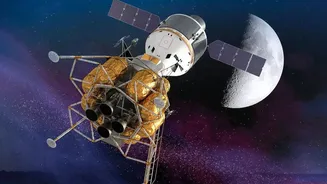
While a flyby mission is a crucial first step, definitively finding life would likely require a lander. A future mission concept, the Europa Lander, would touch down on the surface, drill about 10 centimeters into the ice, and analyze the samples. This depth is believed to be just enough to protect potential biosignatures from Jupiter's harsh surface radiation, which can break down organic molecules. Designing such a mission presents enormous challenges. The lander would need to operate with a high degree of autonomy due to the significant communication delays with Earth and would be powered by a non-rechargeable battery, giving it a very short lifespan in an extremely cold and radioactive environment.
What Would Discovery Mean?
The discovery of even microbial life on Europa would be one of the most profound in human history. It would prove that life is not unique to Earth, suggesting it could arise anywhere the conditions are right. This would radically expand our understanding of biology and the definition of a habitable zone, which is traditionally based on proximity to a star's light and heat. Worlds like Europa, warmed by internal tidal forces, would become primary targets in the search for life elsewhere in the galaxy. It would shift the conversation from 'Are we alone?' to 'What other kinds of life are out there?'.