



A Sugar Found in the Stars
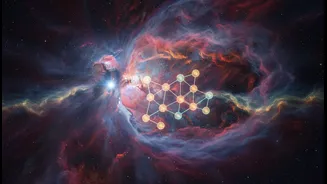
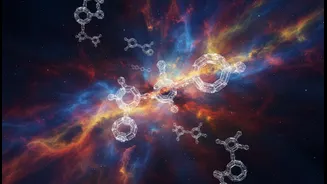
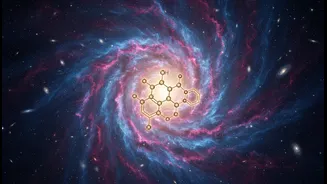
In a remarkable feat of cosmic chemistry, an international team of scientists has identified the first true sugar molecule, erythrulose, floating in a giant gas and dust cloud near the center of our Milky Way galaxy. Located about 27,000 light-years from
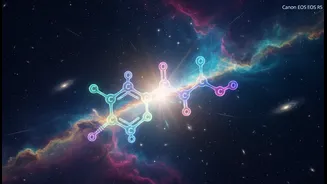
Earth in a molecular cloud known as G+0.693-0.027, the discovery was made using powerful radio telescopes in Spain. By analysing the faint radio signals emitted from the cloud, researchers matched 12 specific spectral lines to the unique chemical fingerprint of erythrulose, confirming its presence. On Earth, this four-carbon sugar is naturally found in red raspberries and is also used in some self-tanning lotions. Finding it in the frigid, sparse environment of interstellar space is a significant milestone.
Why This Cosmic Sweet Spot Matters
Sugars are fundamental to life as we know it. They serve as energy sources and, crucially, form the structural backbone of RNA and DNA, the molecules that carry genetic instructions. Scientists have long debated how the first sugars formed on early Earth, as laboratory simulations of prebiotic conditions haven't produced them in sufficient quantities. The detection of sugars like glucose and ribose in meteorites has long suggested they might have an extraterrestrial origin, delivered to Earth by comets and asteroids. The discovery of erythrulose in the interstellar medium—the raw material from which stars and planets form—provides the first direct evidence that such complex molecules can be synthesised in space before being incorporated into planetary systems.
A Step Up in Chemical Complexity
What makes the erythrulose discovery particularly exciting is its complexity. It is a four-carbon sugar (C4H8O4). Previously, astronomers had found simpler, two-carbon sugar-like molecules, but never a true sugar of this size in the interstellar medium. Intriguingly, the new research found that erythrulose is at least eight times more abundant in the cloud than its simpler three-carbon cousins. This challenges the long-held theory that complex molecules in space form incrementally, one carbon atom at a time. Instead, it suggests that erythrulose may form more efficiently from the combination of simpler two-carbon molecules on the icy surfaces of cosmic dust grains.
Context, Not Confirmation of Life
This is where the crucial distinction lies. Finding a key ingredient for life's recipe is not the same as finding the finished cake. The presence of erythrulose confirms that the universe is a prolific chemist, capable of creating complex organic molecules under extreme conditions of near-absolute zero temperature. Scientists estimate millions of tonnes of this sugar could have rained down on early Earth during a period of intense asteroid and comet impacts known as the Late Heavy Bombardment. This delivery could have enriched the "primordial soup" from which life is thought to have emerged. However, the leap from a collection of prebiotic molecules to a self-replicating, living organism is a colossal one, involving countless steps that are still poorly understood.
The Search Continues
The detection of erythrulose is not an end point but a new beginning. It acts as a powerful signpost for astrochemists, suggesting that even more complex and biologically relevant molecules may be waiting to be discovered. The next major goal is to find five-carbon sugars like ribose, the sugar that forms the backbone of RNA, a leading candidate for the first genetic material. This discovery gives scientists renewed hope that such a find is possible. It reinforces the idea that the ingredients for life are not exclusive to Earth but are likely widespread throughout the cosmos, waiting for the right conditions to take the next, extraordinary step.