
The Problem with Dust
For decades, astronomers have been frustrated by cosmic dust. These massive clouds, made of tiny particles of carbon, silicon, and other elements, are opaque to visible light—the kind our eyes and telescopes like Hubble primarily see. This means that
the very places where stars and planets are actively forming have remained largely hidden from view. Trying to see through these dense clouds with a conventional telescope is like trying to see through thick smoke. The shorter wavelengths of visible light simply scatter and bounce off the dust particles, blocking our view of the incredible processes happening within. This cosmic curtain has left a significant gap in our understanding of how stars, including our own Sun, come into being.
Infrared Light: The Universe's Secret Passageway
The solution lies in a different kind of light: infrared. Infrared radiation has a longer wavelength than visible light. Because of this, it can more easily slip past the tiny dust particles that would otherwise block its path. Think of it like sound traveling through a wall; the low-frequency bass is more likely to get through than high-frequency treble. Similarly, infrared light penetrates the dusty clouds, carrying information from the objects hidden inside. This makes infrared astronomy essential for studying cooler objects that don't shine brightly in visible light, such as the very protostars and protoplanetary disks that are the building blocks of new solar systems. Essentially, where Hubble sees an opaque wall of dust, Webb sees a transparent window into a star-forming factory.
Webb’s Super-Powered Infrared Eyes
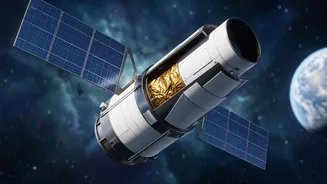
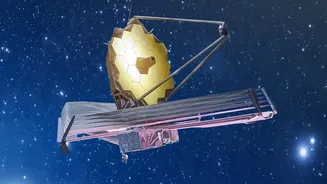
The James Webb Space Telescope (JWST) was specifically designed to be the ultimate infrared observatory. It is equipped with a suite of highly sensitive instruments, most notably the Near-Infrared Camera (NIRCam) and the Mid-Infrared Instrument (MIRI). NIRCam is Webb's primary imager, capturing near-infrared wavelengths that are perfect for piercing through thinner dust clouds and revealing thousands of never-before-seen stars. MIRI, on the other hand, detects mid-infrared light. This allows it to see the glow of the dust itself, which is heated by the young stars forming within, and to peer into the densest, coldest hearts of the molecular clouds. By combining data from these instruments, astronomers get a complete picture: NIRCam shows the stars, and MIRI shows the raw materials for their creation.
A Glimpse Inside a Stellar Nursery
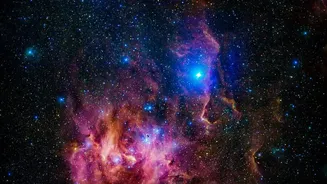
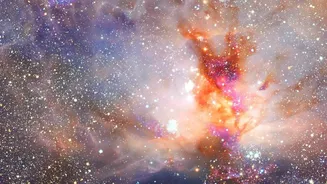
One of the most spectacular examples of Webb's power is its image of the Rho Ophiuchi cloud complex, the closest star-forming region to Earth. Previous images showed it as a dark, relatively obscure area. Webb's infrared image, released to mark its first year of operations, transformed our view into a chaotic, vibrant scene of cosmic creation. The image reveals approximately 50 young stars, many about the mass of our Sun. We can see dramatic jets of material, shown in red, bursting from protostars as they first ignite and push away their dusty cocoons. Crucially, Webb also revealed the tell-tale shadows of circumstellar disks around some of these stars—the swirling rings of gas and dust where planets are beginning to form. It's a snapshot of a process our own solar system went through billions of years ago.
Rewriting the Story of Star Birth
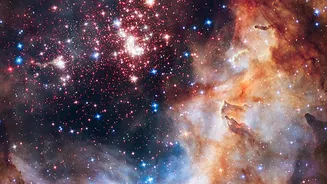
By cutting through the dust, Webb isn't just taking pretty pictures; it's providing crucial data that is transforming our understanding of the universe. For the first time, scientists can witness the earliest, most chaotic stages of a star's lifecycle with incredible clarity. They can analyze the composition of the dust and gas clouds, identifying the ices and organic molecules that may eventually be incorporated into new planets. In iconic locations like the Pillars of Creation, Webb has revealed that the pillars themselves are being actively eroded by the intense radiation from massive young stars, while also showing new stars forming within the dense gas. Each new image from Webb is a new discovery, allowing scientists to answer questions about the origins of stars and galaxies that they once could only dream of asking.