

The Sun powers life on Earth, but it also unleashes violent eruptions that can disrupt our technology. For the first time, two advanced missions—India's Aditya-L1 and Europe's Proba-3—are giving us a combined look at these solar mysteries.
India's Sentinel at L1
Launched in
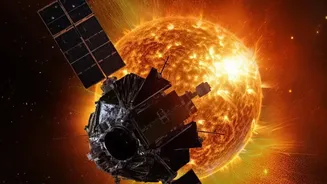
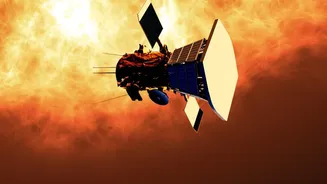
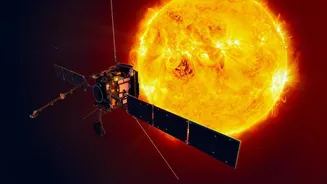
September 2023, Aditya-L1 is India's first dedicated solar observatory, a landmark achievement for ISRO. It is strategically positioned at the Sun-Earth Lagrange Point 1 (L1), about 1.5 million kilometres from Earth. This unique vantage point allows for a continuous, uninterrupted view of the Sun, free from the eclipses or atmospheric distortions that hinder ground-based observation. The spacecraft carries a suite of seven sophisticated instruments. Four are designed for remote sensing, directly observing the Sun's photosphere, chromosphere, and the enigmatic outer atmosphere, the corona. Three are in-situ instruments that measure the local space environment at L1, sampling particles and magnetic fields of the solar wind. The primary goal is to unravel long-standing solar puzzles, such as why the corona is millions of degrees hotter than the Sun's surface and what drives powerful solar eruptions.
Europe's Artificial Eclipse
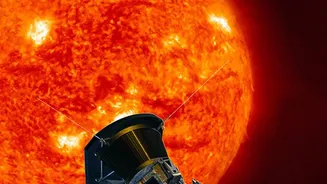
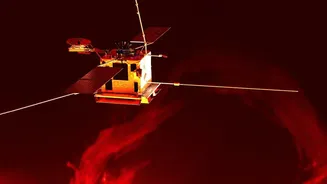
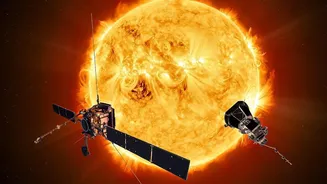
The European Space Agency's (ESA) Proba-3 mission, launched in December 2024 aboard an ISRO PSLV rocket, is a marvel of engineering. It is the world's first precision formation-flying mission, consisting of two separate satellites. One satellite, the 'Occulter', carries a disc that blocks the Sun's bright face, while the second, the 'Coronagraph', flies in its shadow about 150 metres away. This tandem act creates a near-perfect artificial solar eclipse in space, allowing its main instrument, ASPIICS, to observe the extremely faint inner corona with unprecedented clarity. Traditional coronagraphs have an internal occulting disc, but stray light still makes it difficult to see the corona very close to the solar limb. By separating the occulter and telescope by a large distance, Proba-3 overcomes this limitation, opening a new window into the region where solar eruptions and the solar wind are born.
A Tale of Two Coronagraphs
The true power of this celestial pairing lies in the synergy between Aditya-L1's Visible Emission Line Coronagraph (VELC) and Proba-3's ASPIICS. While both are designed to study the corona, they do so in complementary ways. ASPIICS captures high-quality images of the corona, revealing the structure, shape, and movement of solar material. In contrast, VELC is a spectroscopic coronagraph. Instead of just taking a picture, it analyses the light itself, breaking it down to measure properties like the temperature, density, and, crucially, the velocity of the plasma along the line of sight—whether it's moving toward or away from Earth. This is information that an imaging coronagraph alone cannot provide. A recent study published in 'Astronomy & Astrophysics' highlighted this synergy, where researchers combined data from both missions to analyse the same coronal mass ejections (CMEs).
Why Two Views Are Better Than One
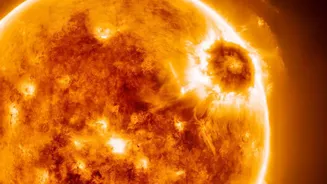
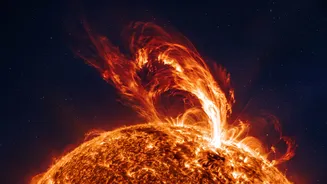
The joint analysis of CMEs in September 2025 showed that combining the two datasets provides a more complete, threendimensional understanding of these events. ASPIICS provided the visual context of the eruption's structure, while VELC provided the 'hidden' third dimension by measuring the speed of the outflowing plasma. Scientists found that the mass and energy estimates from both independent instruments agreed well, which builds tremendous confidence in the measurements. Tracking CMEs in their earliest stages, very close to the Sun, has been a major challenge for solar physicists. This new, combined approach allows scientists to better understand how a CME's energy is distributed and how it evolves right after it erupts, which is critical for improving space weather models. It's like having two eyes instead of one—providing the depth perception needed to truly grasp the scale and dynamics of solar storms.
Protecting Our Technological World
This collaboration is more than just an academic exercise; it has profound practical implications. CMEs that are directed toward Earth can trigger powerful geomagnetic storms, which pose a significant threat to our satellitendependent infrastructure, including GPS navigation, communication systems, and power grids. By getting better measurements of a CME's mass, speed, and direction near the Sun, scientists can provide more accurate and timely space weather forecasts. This allows satellite operators and grid managers to take protective measures, mitigating potential damage. The partnership between AdityaL1 and Proba3 represents a new era in heliophysics, where coordinated observations from multiple spacecraft provide deeper insights than any single mission could achieve alone , ultimately enhancing our ability to safeguard our technological society.