




A Distant Hello from the Sun
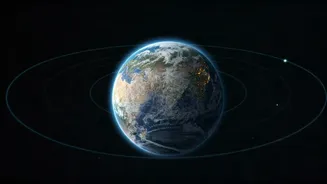
Every year, our planet completes a long, quiet journey around the sun. But this journey isn't a perfect circle. Instead, it’s a slightly stretched-out oval, or an ellipse. This means our distance from the sun changes throughout the year. On July 6, 2026,
Earth will be at aphelion, the point in its orbit where it is most distant from the sun. At that moment, we will be about 152.1 million kilometres away from our star. This is in contrast to perihelion, which occurs in early January, when Earth is at its closest point to the sun, a 'mere' 147 million kilometres away. The words themselves come from Greek: 'apo' meaning far, 'peri' meaning close, and 'helios' meaning sun. This roughly 5 million kilometre difference is a silent feature of our planet's annual rhythm.
The Summer Paradox
It’s a common and logical assumption: if we are farther from the sun, it should be colder. Yet, in the Northern Hemisphere, aphelion occurs in the middle of summer. This seeming contradiction puzzles many, but it highlights a crucial fact about our planet. The nearly 3% change in distance between aphelion and perihelion has a negligible effect on our global temperature and weather. The variation in heat received by the Earth due to this distance change is minimal and not the driver of our seasons. So, if our orbital distance isn't responsible for the heat of summer or the chill of winter, what is?
It's All in the Tilt
The true architect of our seasons is Earth's axial tilt. Our planet doesn't spin upright as it orbits the sun; instead, it is tilted on its axis by about 23.5 degrees. This tilt remains constant and pointed in the same direction as we journey around the sun. During the Northern Hemisphere's summer, the north pole is tilted towards the sun. This means sunlight hits this part of the world more directly, like a flashlight shining straight down, concentrating the energy and bringing warmer temperatures and longer days. Conversely, when the Northern Hemisphere is tilted away from the sun, the light comes in at a lower angle, spreading the energy out and resulting in the colder, shorter days of winter. So, in July, even though the entire Earth is farther from the sun, the Northern Hemisphere's tilt towards it more than compensates, giving us summer.
Our Planet's Changing Speed
This elliptical orbit has another fascinating consequence, described by Johannes Kepler centuries ago. His Second Law of Planetary Motion states that a planet moves fastest when it is closest to the sun and slowest when it is farthest away. This means that during aphelion in July, Earth is moving at its most leisurely pace, approximately 29.3 kilometres per second. Come perihelion in January, it speeds up to about 30.3 kilometres per second. This change in speed is a direct result of the conservation of angular momentum. An interesting side effect of this is that the Northern Hemisphere's summer, which occurs around aphelion, is actually the longest season of the year, as Earth takes more time to travel through this slower part of its orbit.
The Cosmic Calendar
Thinking about aphelion forces us to look beyond our daily calendars and consider a much grander, cosmic clockwork. Our days, seasons, and years are all dictated by these silent, powerful mechanics of gravity and motion. The tilt of our axis gives us the rhythm of the seasons, the rotation on that axis gives us night and day, and the slow, elliptical dance around the sun defines our year. Events like aphelion are gentle reminders that we are passengers on a celestial body, moving at incredible speeds through space. While the 5-million-kilometre extra distance at aphelion doesn't chill our summers, knowing it's there connects our terrestrial experience of time to the vast and elegant physics of the solar system. It turns a simple date on the calendar into a marker of our place in a cosmic journey.