






A Planet's Disappearing Act
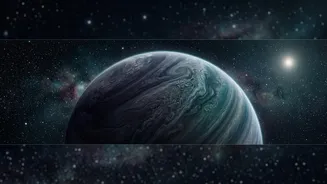
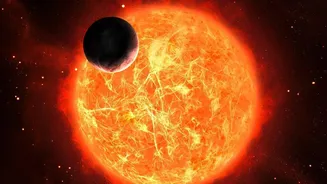
About 1,000 light-years from Earth, a giant planet known as TOI-2535 b has been playing a game of cosmic hide-and-seek. For seven years, from 2019 to early 2026, NASA's Transiting Exoplanet Survey Satellite (TESS) watched this 'hot Jupiter'—a gas giant orbiting
extremely close to its star—pass in front of its sun every 8.25 days. This event, called a transit, causes a tiny, predictable dip in the star's light, which is how TESS discovers planets. But then, the dips stopped. TOI-2535 b, which had been reliably crossing its star, seemed to have disappeared from our view. It was the first time astronomers had witnessed a planet's transit cease around a single star.
The Telltale Wobble
The planet didn’t actually go anywhere. The clues to its vanishing act were there all along. Even before the transits stopped, astronomers noticed that TOI-2535 b was not keeping a perfect schedule. Its transits would sometimes occur up to six hours early or six hours late, one of the largest timing variations ever recorded for a hot Jupiter. This erratic timing suggested that something else was pulling on the planet, disrupting its otherwise regular clockwork orbit. This gravitational tugging caused the planet's orbit to precess, or wobble, much like a spinning top. Over seven years, this wobble was so extreme that it tilted the planet's orbital plane completely out of our line of sight, meaning it no longer passed between its star and Earth.
Enter the Hidden Companion
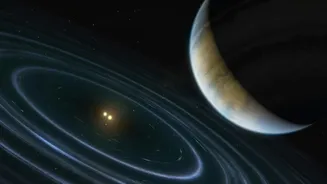
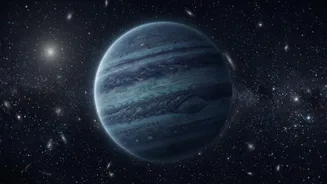
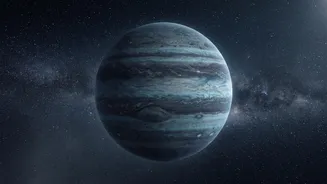
A planet can't make its own orbit wobble so dramatically. The only explanation was the gravitational influence of another, unseen planet in the same system. By modeling the changes in both the timing of the transits and their shape—they became shorter and shallower before disappearing—scientists concluded that a second massive planet must be orbiting nearby. This hidden companion, now catalogued as TOI-2535 c, is thought to be at least the mass of Saturn. Its own orbit is also tilted relative to TOI-2535 b, creating a powerful gravitational relationship where the two giants are locked in a celestial dance, constantly pulling on each other and forcing their orbits to change on a remarkably fast timescale.
A New Window into Planet Formation
This discovery does more than just solve a mystery; it challenges our understanding of how planetary systems evolve. Hot Jupiters like TOI-2535 b are already considered oddities because they orbit too close to their stars to have formed there. The prevailing theory is that they form farther out and migrate inward. The presence of a massive, nearby companion suggests a specific type of migration. Instead of being violently flung inward by a chaotic event, this pair likely migrated together more gently. The discovery of their tilted orbits shows that even these 'gentler' systems can undergo extreme and dynamic evolution, a finding that adds a crucial new piece to the puzzle of planet formation.