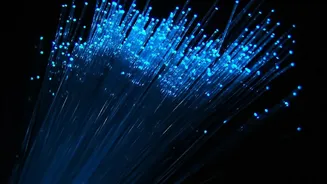





Beneath the waves, a silent revolution is underway. The same submarine fiber optic cables that carry over 95% of global internet data are being repurposed into a vast, underwater sensory network, unlocking secrets of the deep ocean.
The Internet's Hidden Backbone
More than 1.5 million
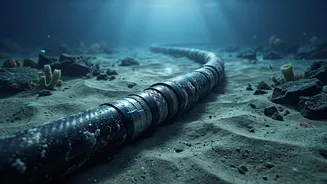
kilometres of submarine cables crisscross the globe, forming the indispensable backbone of our digital world. These cables, typically no thicker than a garden hose, are laid on the seabed, sometimes at depths greater than Mount Everest is tall. In shallower waters, they are buried to protect them from ship anchors and fishing activities, but in the vast, remote deep sea, they simply rest on the ocean floor. For decades, their sole purpose was to transmit data at the speed of light. Now, scientists and engineers are transforming this existing infrastructure into one of the most powerful tools for understanding our planet.
Turning Cables into Sensors
Two key technologies are leading this transformation: Distributed Acoustic Sensing (DAS) and Science Monitoring And Reliable Telecommunications (SMART) cables. DAS technology turns a standard fiber optic cable into a sequence of thousands of virtual microphones or seismic sensors. It works by sending pulses of laser light down the fiber and analysing the tiny backscattered reflections. Any disturbance that causes the cable to stretch or vibrate, even by a nanometer—such as a seismic wave from an earthquake, the movement of a ship, or even the sound of a whale—changes the pattern of that reflected light. By analysing these changes, scientists can detect and locate acoustic and seismic events along the entire length of the cable with remarkable precision.
A New Generation of SMART Cables
While DAS repurposes existing cables, the SMART cable initiative involves integrating dedicated sensor packages directly into new telecommunications cables. Supported by UN agencies, this effort equips the signal repeaters found along cables with instruments to measure temperature, pressure, and seismic acceleration. These sensors 'piggyback' on the cable's power and communication systems, allowing for persistent, real-time data collection from the deep ocean—an environment that has historically been incredibly difficult and expensive to monitor. The first demonstrator SMART cable was deployed off the coast of Sicily in late 2023 to monitor volcanic activity, with more extensive systems planned for the Atlantic and Pacific set to be installed by 2026.
Unlocking Bathymetric and Seismic Secrets
The term 'bathymetry' is the underwater equivalent of topography—it's the science of mapping the depth and shape of the ocean floor. This data is crucial for everything from creating nautical charts for safe navigation to understanding marine habitats and modeling climate change impacts like sea-level rise. By using the seismic and acoustic signals detected by DAS and SMART cables, scientists can infer details about the seafloor. The way sound waves and seismic echoes travel and scatter reveals the underwater terrain, sediment layers, and the location of undersea faults. This technique provides a continuous profile along the cable's route, offering a level of detail that complements other methods like satellite-derived bathymetry and traditional ship-based sonar.
A Safer and More Understood Planet
The applications of this technology extend far beyond simple mapping. By providing dense, real-time seismic data from undersea fault zones, these cables can dramatically improve earthquake and tsunami early warning systems. Data on ocean bottom pressure and temperature is vital for tracking climate change, ocean circulation patterns, and rising sea levels. This network can also enhance maritime security by detecting and identifying vessel activity, helping to protect the critical cable infrastructure itself from anchor drags or sabotage. Essentially, the internet's own plumbing is becoming a planetary-scale nervous system, listening to the murmurs of the Earth in unprecedented detail and helping us prepare for its most powerful events.